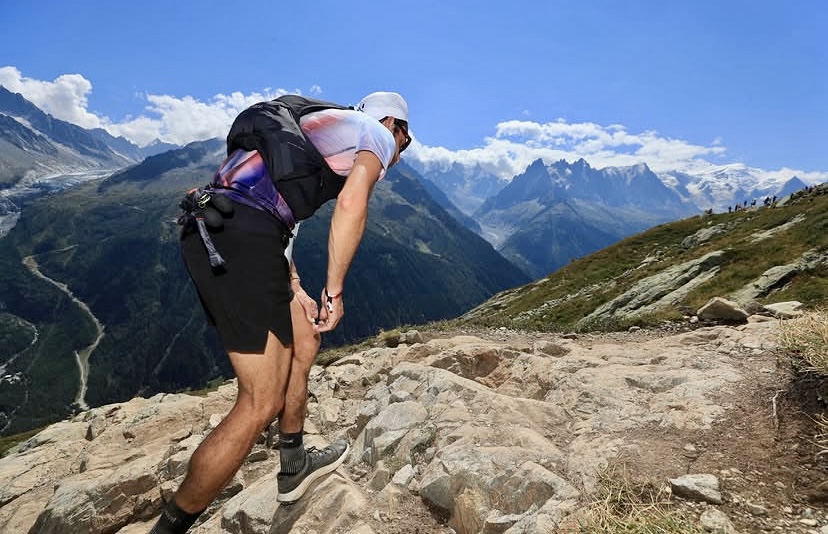

On the road, the best marathons are run at an even or slightly negative split, and “start slower, finish faster” is sound advice. In the mountains that advice breaks. In Ultras, if we look at the GAP of winners, nobody ran a negative split, and the slowdown came mostly where a slow start cannot help: on the descents.
The reason is the kind of fatigue. A road marathon is limited mainly by the metabolism (the engine), and saving early can be spent late. A mountain ultra is limited as much by the neuromuscular (the chassis): quads damaged by thousands of meters of braking, which a slow first climb does not protect. The data also show that GAP, the tool we use to judge pacing, is itself a model of the metabolism and misreads the descents.
On the road, the fastest races are even or on negative splits, but the slower the runner, the bigger the fade.
- Record races: Kelvin Kiptum’s 2:00:35 world record in Chicago 2023 was 60:48 for the first half and 59:47 for the second.
- Mass races: at Boston 2022–2025 only about 10% of finishers ran a negative split. Sub-3:00 runners slowed on average 5% in the second half, 4-hour-plus runners 18% (Marathon Handbook). In 190,228 New York finishers (2006–2011), the best runners also varied their speed the least (Santos-Lozano et al., 2014).
So the negative split is not what most road runners do; it is what the best road races look like, and what pacing advice aims for. It works because of three things:
- The cost per kilometre is constant. Same surface, same gradient, same stride for all the race. A kilometre saved at the start costs the same as one run at the end.
- The limit is metabolic. Substrate utilization, heat and how close the runner sits to threshold decide the fade. Running a little under threshold early spares glycogen and heat that can be spent later.
- Muscle damage is moderate. A marathon is mostly concentric work at a steady cadence; the legs hurt, but they still produce force at the end.
Ok, that’s marathons, How is it in flat ultras? Distance alone does not break even pacing: the best road and track ultras are run almost as evenly as a marathon. Aleksandr Sorokin’s 100 km world record (6:05:41, 2022) went through 50 km in 3:01:50, so the second half was only about 1% slower. In his 2021 track 100-miler (11:14:56) the first 50 miles took 5:32:01 and the second 5:42:55, about 3% slower. Compare that with the 10–23% GAP fade of the winners and contenders at Western States and UTMB.
Mass fields in flat ultras do slow down —the usual shape is a reverse J: a fast start, a long fade and a small final push, seen in 24-hour track races and in the Comrades up run (Inoue et al., 2019; Manchip, 2024). But, as on the marathon, the faster the runner the more even the pace: in the 24-hour study the best runners started more conservatively and varied their speed less.
The reason is the same as on the road. On a flat course each kilometre costs the same, the stride never changes and there are no long braking descents, so muscle damage builds slowly and evenly. The limit stays mainly metabolic and a controlled start can still be cashed in late. Mountain ultras add a second limit that no start strategy can control: the descents. Comrades for example, with its long downhills, sits between the two.
In the mountains none of the three conditions hold, so the road logic of “save now, spend later” stops working.
- The cost per kilometre is not constant. A kilometre at +25% costs more than the double of a flat one; a kilometre at −10% costs less than a flat one. The course decides where the effort goes, not the runner. A race that starts with a long climb and ends on a long descent will show a “fast finish” on the clock and a “slow finish” in GAP without the runner changing effort at all.
- A second limit appears: the muscles themselves. Descending is eccentric work. It costs little oxygen but damages muscle fibres, and the damage accumulates with every metre of descent. Damaged quads lose force and stiffness, so downhill speed falls first, then flat speed. This happens at almost any pace: a slower first climb does not reduce the damage from the next descent.
- The movement changes. Power-hiking on steep climbs, technical sections, night, navigation, altitude… all change the speed–effort link. The same heart rate can mean very different speeds from one section to the next.
The practical consequence: in a mountain ultra the fade has two parts. The metabolic part can be managed the road way. The mechanical part can only be managed by how you descend, and by the training you did months before.
GAP is a model of the engine
GAP converts pace on a slope into the flat pace with the same cost, but “cost” means oxygen or heart rate, not muscle damage, and on steep or technical descents that is the wrong focus.

- Uphill: the models agree. Strava’s population curve and my own COROS curve are almost identical up to about +15%; the oxygen model (Minetti) is a little harsher.
- Downhill: they split. The oxygen model says a −20% kilometre costs half a flat one, because descending uses little oxygen. Strava and COROS, built from heart rate and real runners’ speeds, count it as a full flat kilometre: people simply cannot run steep descents as fast as their oxygen budget would allow.
- Not shown: technical footing, roots and rocks, a wet trail, night, and quads that no longer brake. On a runnable −8% fire road GAP is fair. On a rocky −25% it mostly measures how good and how fresh your legs are.
So a late “GAP slowdown” on descents is often not lower effort but lost muscle function. And a single GAP number for the whole race mixes that with the climbs, where GAP works well.
Total GAP vs GAP by terrain:
Splitting each race into uphill, flat and downhill kilometers shows what one total GAP number hides: in the short races there is almost no fatigue on any terrain, and in the 100-milers the descents decide.

| Race | Runner | Distance / gain | Time | Overall, last quarter vs first | Overall, 2nd half vs 1st | Uphill | Flat | Downhill |
|---|---|---|---|---|---|---|---|---|
| Sierre-Zinal 2024 | Kilian | 31.8 km / +2,240 m | 2:26 | +14.5% | +4.9% | −3.9% | −3.3% | +0.3% |
| Zegama 2024 | Kilian | 42.5 km / +2,470 m | 3:39 | +11.8% | +15.2% | +13.6% | +11.7% (+7.6%) | +1.2% (−0.1%) |
| Western States 2025 | Kilian | 160 km / +4,000 m | 14:20 | +11.1% | +10.2% | +10.1% (+14.6%) | +7.5% (+6.3%) | +15.3% (+21.4%) |
| Western States 2026 | Puppi | 161 km / +3,950 m | 13:51 | +9.7% | +11.1% | +8.6% (+9.7%) | +10.0% (+9.0%) | +13.4% (+10.2%) |
| Hardrock 2022 | Kilian | 162 km / +9,040 m | 21:36 | +13.8% | +13.3% | +14.5% (+20.3%) | +4.9% (+0.2%) | +9.0% (+1.4%) |
| UTMB 2022 | Kilian | 173 km / +9,550 m | 19:51 | +32.2% | +22.8% | +16.9% (+19.5%) | +31.1% (+54.8%) | +27.3% (+40.5%) |
| UTMB 2026 | Dhiman | 168 km / +8,650 m | 18:16 | +29.6% | +17.2% | +18.2% (+26.5%) | +16.0% (+26.9%) | +16.3% (+29.6%) |
Terrain columns: second half vs first half; in brackets, last quarter vs first quarter where both quarters hold enough of that terrain (the short races don’t). Positive = slower. Uphill > +4%, downhill < −4%.
The gap between the two “overall” columns is itself the course talking. For example, Sierre-Zinal reads +14.5% last quarter vs first, but only +5% by halves and nothing within any terrain: the race simply starts with 1,300 m of steep climbing and ends on the balcony trail and the drop to Zinal, and the GAP curve values those kilometres differently – The downhill is more limited by how fast you can technically run in a single track downhill more than the pure engine that can be shown in the first non technical uphill.
Different patterns: short races barely fade within any terrain; at Western States the difference is the last quarter of descents; at Hardrock the climbs fade and the descents hold; at UTMB two runners with the same overall fade faded in different ways.
Short races: course shape, not fatigue
- Sierre-Zinal 2024: within each terrain the second half was as fast or faster (uphill −4%, flat −3%, downhill 0%). The clock shows a fast finish and total GAP a slow one; both are the course, not the runner.
- Zegama 2024: the descents held completely (+1%). The +14% uphill and +12% flat in the second half come mostly from Aizkorri’s steep, rocky ridge, terrain the GAP curve treats like a smooth slope, and where slowing down is because technicality.
Western States: same total fade, different last quarter
Over the full second half, I (2025) and Francesco Puppi (2026) faded almost the same: +10% and +11%. The difference sits in the last quarter of descents: Kilian +21%, Puppi +10%, or 6:08 against 5:33 per km of downhill GAP.
Puppi was not “saving” anything early. He ran the high country and the canyons faster and was 20 minutes up by Foresthill; after that the gap grew only 8 more minutes. What separated the two at the end was not effort but legs that could still descend. The difference of temperatures during those years can also show how an aggressive pace can be held better or worse.
Hardrock: the climbs fade, the descents hold
Hardrock 2022 is the opposite of UTMB 2022, six weeks apart. The overall fade was a moderate +13%, but it sat on the climbs: +15% over the second half and +20% in the last quarter, while flats (+5%) and descents (+9%, and +1% in the last quarter) held.
Two things likely explain it. The course runs mostly between 3,000 and 4,200 m, where every climb is limited by oxygen, so the engine fades. And its descents are steep, loose and technical in a big part: footing caps the speed early as much as late, so there is less room to run them hard and less to lose at the end. GAP cannot separate that cap from fatigue.
UTMB: two kinds of fade
I in 2022 and Ben Dhiman in 2026 slowed by almost the same amount from first to last quarter: +32% and +30%. How we slowed was opposite.
- Dhiman lost 16–18% on every terrain alike — a whole-body fade, the kind the road strategy addresses.
- I held the climbs better (+17%) but lost 31% on flats and 27% on descents: the mechanical pattern. I wrote after the race that my muscles felt strange from the start after covid, specially in the downhills.
Two runners, same total GAP fade, and the total says nothing about which problem each one had.
The strategy
In a mountain ultra the target is not a negative split but an even effort on each terrain, with the descents run under capacity early so the legs still work late.
- Pace climbs by effort. On climbs, heart rate, breathing and GAP agree. Hold the effort you can sustain for the race distance; going slower here buys metabolic reserve, as on the road.
- Run early descents below what the legs could do. Downhill speed costs little oxygen, so it feels free, but each fast meter of braking spends muscle needed at the end. Holding back is invisible on heart rate.
- Judge pacing and GAP by terrain, not by total GAP. After a race, split GAP into uphill, flat and downhill. A downhill fade much bigger than the uphill one points to legs, not engine, and to downhill training rather than more aerobic work.
- Train the muscles. Muscle adapts quickly to eccentric work: a block of long, fast descents before a race reduces damage on race day. Weekly downhill volume belongs in the plan of anyone targeting a mountain ultra.


Leave a Reply