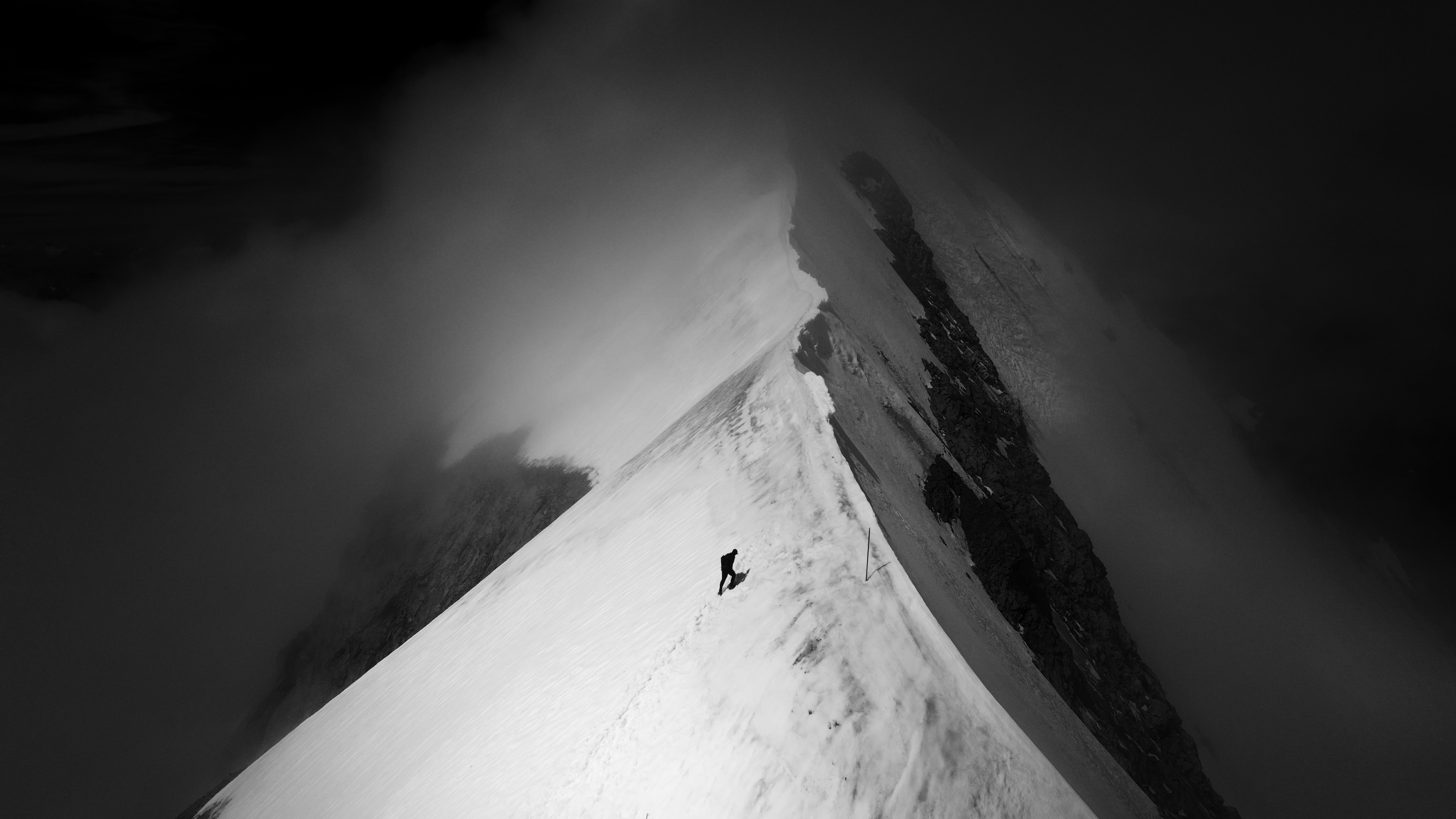

When I embarked in the project of connecting the 4000m summits in the Alps, I knew that the most challenging thing it wouldn’t be the physical load neither the technical difficulties, but the cognitive load. How to manage the amount of stress for many hours and many days in a terrain that required full concentration for many hours every day since most of the climbing would be soloing, sometimes in bad weather or in bad rock, and often in a sleep deprivation and extreme fatigue?
With the experience we can develop a big tolerance to risk, to feel comfortable in extreme situations so our brain is not entering a fight-to-fight mode or stressing for most of the time so we can focus, be calm, not only to take more resonated decisions but also to spend less energy (the brain uses at rest 20% of the body total energy!) But I knew that I would be pushing the limits of my brain in an activity such as this one.
In the past, I have experienced different phenomena where the brain showed me answers in a way I can’t completely understand. For most of us it’s “easy” to understand how the body works, even if we are far for understanding most of it, we can have an idea of how mitochondria works, how the lactate recycles or how a bone heals after a fracture. But what happens when the brain is pushed to the extremes? Why we sometimes see things we can’t understand? Why do we have hallucinations? And how the hell this things happen? Here I would try to describe some of the phenomena I have experienced in my skin/brain, and what I’ve learned about it.
Who is this guy following me?
I was climbing down from Everest. It had already been a long “day”, without much to eat or drink. It was in the night and a snow storm was hitting the mountain. I remember arriving at 8300m, where I left some gear in my way up. From there, I don’t remember anything for a long period of time. A black hole in my memory. I “woke up” 4 hours later, I was down climbing in a technical section, traversing to my left in rock and mix terrain. I didn’t knew where I was. I’m at the north-east face? at the south face? How the hell have I arrived here! Someone is following me, always at around 20 meters of distance. I can’t see his face. I can’t recognize him. I know it’s an hallucination but I can’t ignore it. I feel responsible for this person, I need to bring him back to a safe place. I feel angry at him for making me going slow, for taking me out of the route I was climbing down and going to his rescue…
This is a pretty common phenomena called the third man and it’s often described as a companion who offers support, guidance, or encouragement. The term originates from the experiences of polar explorer Sir Ernest Shackleton, who, during his 1914–1917 Antarctic expedition, recounted the sense of an invisible presence that helped him and his companions survive. Since then, it has been reported by mountaineers, astronauts, sailors, and others in life-threatening situations.
This phenomenon is often seen as a dissociative response to extreme stress, fatigue, hypoxia or isolation. These conditions can profoundly affect the brain, leading to altered perceptions of reality. The experience is thought to arise from the brain’s attempt to cope with overwhelming stress and maintain psychological resilience.
The “Third Man” can be considered a type of hallucination, although it differs from more traditional hallucinations because it is often reported to be comforting and purposeful, rather than frightening or chaotic.
Studies:
Brain Activation and Dissociative Experiences: Neurological research has indicated that extreme stress can lead to alterations in brain activity, particularly in the parietal lobe, which is responsible for processing spatial orientation and self-awareness. Changes in this brain region could explain why individuals in these extreme states feel like they are being accompanied by another person, as their brain misinterprets sensory input.
Hypoxia and Its Effects on Cognition: Hypoxia is a well-known cause of altered perception in high-altitude climbing. A 2012 study by Ferris et al., published in High Altitude Medicine & Biology, discusses the cognitive and perceptual changes due to oxygen deprivation at high altitudes. They explain that reduced oxygen levels can impair brain function and lead to dissociative experiences, such as out-of-body sensations or feelings of being accompanied by another presence.
Psychological Coping Mechanisms: A 2016 article in Frontiers in Psychology by Geiger et al. explored how individuals in extreme environments use coping strategies. The study suggested that such experiences might serve as a way for the brain to “externalize” a part of itself in order to provide guidance or comfort during traumatic situations. This externalized figure might represent a deeply rooted need for social support in life-threatening conditions.
Case Studies of High-Altitude Mountaineers: Dr. John Geiger, who wrote The Third Man Factor, compiled numerous accounts of climbers and other adventurers experiencing this phenomenon. In 2008, Geiger published an article in The Annals of the New York Academy of Sciences discussing these case studies, suggesting that the experience of a “third man” might be triggered by a combination of factors such as isolation, extreme environmental stress, and sensory deprivation.
https://journals.sagepub.com/doi/10.1016/j.wem.2023.07.004
An Episode of “Third Person” Phenomenon Involving Somesthetic and Visual Hallucinations in a World-Class Extreme Altitude Climber, Eduardo Garrido: https://pubmed.ncbi.nlm.nih.gov/37620238/
Misperceptions and hallucinatory experiences in ultra-trailer, high-altitude runners: https://pubmed.ncbi.nlm.nih.gov/32489196/
When The Brain Shuts Down Non Essential Functions
So I was tired, in the middle of the night, in a storm, in a technical face above 8000m. And I didn’t know where I was. I didn’t know if to escape from there I needed to traverse to the right, back to the left, to climb down or to climb up to go down the other side. Or maybe it was just a dream – a nightmare – and I was already sleeping in my tent in the basecamp and so if I jumped from there I would woke up… When I realized that continuing without a plan was probably just driving me to death one way or another, I stopped for a moment, find a small platform where I could stand in a squat position or sitting. I needed to rest, to find some clarity before continuing. I sit with my head in between my legs and with the wall behind me protecting a bit from the snowfall I closed the eyes. I slept a moment – a few seconds, maybe a minute – and woke up with a more clear brain. I looked at my watch, it didn’t had a card but looking at the gpx line I could estimate that I was in the north face, about 1km from the ridge. I remembered that at about 7700m it was a snow line where it was “easy” to cross to the ridge, so I needed to climb down for 300-400m towards the east to find that escape. I got back to the normal route and down to the base camp. But what happened during the 4 hours where I have a black hole in my memory? I was for sure active, taking complex decisions to find a way to climb down and navigate in difficult terrain. So my brain was working well, and my body too. So why I couldn’t remember what I was doing one second before?
When I came back home I made a call with my psychology teacher from university and we started looking into it. During extreme fatigue and stress the brain can shut down certain functions, such as memory formation, to conserve energy and focus on essential survival tasks. This is known as cognitive resource allocation. The brain prioritizes functions crucial for survival, such as motor control, decision-making, and heightened sensory awareness, while reducing energy expenditure on non-essential tasks like memory formation or complex thinking.
The brain’s response to extreme fatigue, stress, or danger is largely driven by the autonomic nervous system and involves multiple mechanisms.
The brain has a finite amount of energy, and in extreme conditions, it reallocates energy away from processes like episodic memory formation (the recording of new memories) to focus on basic survival. This is particularly evident in the hippocampus, the region responsible for long-term memory formation, which becomes less active under stress or hypoxia, limiting the ability to form new memories during the event.
When the brain is overloaded with survival-related tasks—such as assessing immediate threats or maintaining physical function under fatigue—it minimizes cognitive processes that aren’t directly contributing to the moment-to-moment survival. Memory encoding, abstract reasoning, and planning for the future may be suppressed.
Studies:
- Memory Impairment under Extreme Fatigue and Stress:
The effects of acute stress and fatigue on working memory. The study found that during highly stressful situations, individuals had significantly impaired memory recall and retention. This suggests that under extreme fatigue and stress, the brain may suppress memory functions to focus on more immediate tasks like problem-solving and motor control.
https://www.jneurosci.org/content/29/32/10111
- Hypoxia and Cognitive Function:
In high-altitude or oxygen-deprived environments, the brain must prioritize essential survival mechanisms. A study by Feddersen et al. (2015) published in Frontiers in Physiology explored cognitive impairment in mountaineers exposed to hypoxia. It found that memory function was one of the first cognitive abilities to decline as oxygen levels dropped, while basic survival instincts, motor function, and threat detection remained intact. This supports the idea that the brain reallocates resources in extreme conditions to essential functions like maintaining bodily homeostasis. - Stress, Fatigue, and Memory Suppression:
A 2011 study by Diamond et al., published in Nature Reviews Neuroscience, reviewed the effects of stress hormones like cortisol on the brain’s ability to form and retrieve memories. Chronic stress or acute survival situations trigger a flood of cortisol, which impairs the hippocampus and prefrontal cortex, regions critical for memory and executive functioning. This shift in resource allocation is thought to be a survival mechanism to focus on immediate physical and cognitive tasks rather than storing long-term memories. - Decreased Neural Activity in Prefrontal Cortex:
The prefrontal cortex (PFC) is crucial for complex decision-making, social behavior, and memory. A study published in Biological Psychiatry by Arnsten et al. (2009) demonstrated that under extreme stress or prolonged fatigue, PFC activity decreases significantly, leading to impaired executive function and memory formation. This is due to the brain’s redirection of energy to subcortical regions, like the amygdala, which are more involved in automatic, survival-related responses such as fear processing. - Cognitive Resource Depletion and Sleep Deprivation:
A study on sleep deprivation by Killgore et al. (2008) published in Sleep found that during prolonged periods without sleep, individuals show significant impairments in memory, emotional regulation, and cognitive flexibility. The study highlighted that during states of extreme fatigue, the brain focuses on sustaining basic wakefulness and motor control, while suppressing memory and higher-order thinking.
I know this place but I haven’t been here before
It was the 5th day in my pyrenees 3000ers link up, fatigue and sleep deprivation was high. At that point I had been going non stop for about 30h, and the previous sleep was of 1h30 after a 24h non stop push. We were climbing on a ridge, at some point my phone felt down (I’m not sure but I believe that loosing my phone, where I had all the info about the route, topos, a way to communicate with team, etc it did make a difference increasing the isolation and meaning that to retrieve or find informations necessary to continue I would need to use more my memory and brain function instead of just having access to an external source for it). After a hour or so, still in the ridge I had a first episode of Déjà-Vu. I did a steep down climb and started climbing a crack. I “remembered” that it would be this diagonal crack with a piton… a couple hours after, in the dusk, we were climbing up a summit and I “remembered” a short cut, arriving at the summit just before dark… Going down I “remembered” meeting after a grassy couloir a group of friends, and myself running in front while the friends would be chatting running behind me. I had a few more déjà-vu episodes like those in the next 2 days. Some when I was alone, some with people with me, some at night and some at day. All of them felt that was retrieving some information I needed to either find the route but mostly to felt comfortable with the situation I was getting on (when getting lost I had a deja vu of a future moment where I was again in the route, when I was stressing about getting to a technical section in the dark, having a deja vu of being there before the night was dark…
“Déjà vu” experiences can be explained by a shift in the hippocampus: Instead of memorizing the context of the action, storing it and restoring it as a memory, with fatigue, stress, lack of sleep, the hippocampus will restore the memory before even being aware of its perception. That works for the immediate, when the memory is from something that is just about to happen, but sometimes we can have memories of events that will happen not in the immediate but in a longer period of time where the hippocampus shift can’t explain it.
When Time Stops
I was climbing up in the Khumbu icefall. It was early october and at that time we were the only expedition – we were 2 person- in the mountain. The week before it had been a lot of snowfall and we were opening track to the knees. Avalanches were falling in both sides of the mountain. Somewhere in the upper icefall, around 6000m I was climbing a steep slope I broke an avalanche that carried me down, and down inside a crevasse. I stopped in a snow bridge about 10m inside the crevasse. During the fall I remember that time slowed down. Everything happens in less than 10 seconds but for me it took minutes. I remember seeing the snow sliding slowly, I could see around inside and “swim” to the right, falling into the crevasse I saw the hole towards the bottom and the snow bridge there at my right and myself fighting to fall there.
The phenomenon of time “slowing down” during life-threatening events—often called “Bullet Time” or Subjective Time Dilation—is a well-documented psychological experience. While it feels like the physical world has slowed to a crawl, scientific research suggests the reality is more about how your brain processes and stores information during a crisis.
Scientific explanations generally fall into two categories: the “Memory Density” theory and the “Internal Clock” theory.
- The Memory Density Theory (Retrospective)
The most influential study on this topic was conducted by neuroscientist David Eagleman in 2007. He wanted to know if the brain actually speeds up its “frame rate” (like a high-speed camera) during fear, or if it just feels that way afterward.
- The Experiment: Participants were dropped from a 150-foot tower into a net (free-falling for about 3 seconds). They wore a “perceptual chronometer”—a device on their wrist that flashed numbers at a speed slightly too fast for the human eye to see under normal conditions.
- The Result: If their brains were actually “speeding up” in real-time, they should have been able to read the numbers. They could not.
- Conclusion: Time doesn’t actually slow down in the moment. Instead, because the situation is terrifying, the amygdala (the brain’s emotional center) kicks into overdrive, forcing the brain to record memories with far more detail and density than usual. When you look back at the event even a second later, your brain sees a “thick” file of data and assumes the event must have lasted much longer.
2. The Internal Clock & Arousal Theory (Prospective)
Other researchers, such as Sylvie Droit-Volet, argue that time dilation might happen in the moment due to increased physiological arousal (the “Fight or Flight” response).
- The Mechanism: When you are in an accident, your heart rate spikes and your brain is flooded with adrenaline. This speeds up your internal pacemaker.
- The Effect: If your internal “clock” is ticking faster than the world around you, the external world appears to be moving in slow motion by comparison.
- The Interoceptive Salience Model: This theory suggests that our perception of time is tied to our “metabolic cost.” When our body is working at a high intensity to survive, we become hyper-aware of every millisecond.
The brain regions involved in those mechanisms are the Amygdala (Responsible for the emotional significance and the “high-density” memory encoding) the Prefrontal Cortex (Switches into a hyper-focused state, filtering out all irrelevant information (like background noise) to focus purely on the threat) and the Insular Cortex (Integrates bodily sensations (heartbeat, breathing) with our sense of time.)
- Stetson, C., Fiesta, M. P., & Eagleman, D. M. (2007).“Does Time Really Slow Down during a Frightening Event?”PLoS ONE, 2(12), e1295. Link to Study
- Key finding: Subjective time expansion is a function of memory, not increased perceptual resolution.
- Droit-Volet, S., & Meck, W. H. (2007).“How emotions shape our perception of time.”Trends in Cognitive Sciences, 11(12), 504-513.
- Key finding: Emotional arousal increases the speed of the internal clock, leading to overestimations of duration.
- Wittmann, M. (2017).“Why Time Slows Down during an Accident.”Frontiers for Young Minds, 5, 32.
- Key finding: Discusses the role of the “self” and the cingulate cortex in processing personal threats and time.
- Arstila, V. (2012).“Time Slows Down during Accidents.”Frontiers in Psychology, 3, 196.
- Key finding: Argues that some people do experience a genuine increase in cognitive speed (mental quickness) during accidents.
Out of my body
The day after the previous episode of the avalanche I was at C2 in Everest. It was my friend Carlos – who was there to film – and I the only persons in the mountain and it was charged with snow. The previous day, besides the avalanche I broke, multiple avalanches had been collapsing from Nuptse and Lhotse faces. During the evening while I was preparing for the attempt the doubts were high – mountain very charged that made the route choice difficult, I was going solo and very light and basically was thinking to start climbing in the South East face in a rock spur and from there decide in the go what seemed the less dangerous. In the night, while I put my gear, exit the tent and start walking in the glacier I didn’t experienced it from my eyes but as I was seeing it from above, and I couldn’t experience any physical sensation ( the cold wind, the touch of the gear, the effort…) it was like I was witnessing the scene like an spectator. This lasted for a couple of minutes until I “entered” my body again.
In stressful or life-threatening situations, the brain may trigger an Out-of-Body Experience as a protective “circuit breaker.” While these experiences can feel mystical, researchers have identified specific neurological mechanisms that explain why our sense of “self” can become detached from our physical body.
1. The “Switch” in the Brain: The Temporoparietal Junction:
Scientific research points to a specific region called the Temporoparietal Junction (TPJ) as the primary seat of OBEs. The TPJ is a hub that integrates information from your senses—specifically your vision, your sense of touch, and your vestibular system (balance).
Under extreme stress, the brain may fail to integrate these different sensory streams. When the TPJ is “overloaded” or malfunctions due to stress hormones, your brain can no longer match what you see with where your body feels it is.
2. Dissociation as a Defense Mechanism:
From a psychological perspective, OBEs are classified as a form of dissociation. In highly stressful or traumatic events, the brain uses dissociation to “unplug” from an overwhelming reality to protect the psyche from immediate pain or terror.
Research suggests that when the “Fight or Flight” response is impossible (e.g., being trapped or facing an unavoidable accident), the body may enter a “freeze” or “dissociative” state.
There is some neurological studies using fMRI that have shown that during these states, there is decreased perfusion (blood flow) in the medial prefrontal cortex—the area linked to our sense of self—and the visual association areas. This lack of integration can cause the feeling of being a “detached observer” of your own life.
3. The Role of Stress Hormones and Neurochemistry
Acute stress triggers a flood of chemicals like cortisol, adrenaline, and endogenous opioids. Some researchers hypothesize that extreme stress can trigger the release of chemicals that act similarly to dissociative anesthetics like ketamine. These chemicals block NMDA receptors in the brain, which can disrupt the communication between the body and the mind, leading to the sensation of floating or departing the body.
Making the pain disappear.
During a long traverse in the Alps I was jogging down in a glacier when one of my crampons got stocked in the leashes of the other crampon and I felt in the ice. I wasn’t going fast and didn’t felt from high but the ice was hard and in my chest pocket I had a GoPro and a GPS tracker, and those are pretty hard, the ice is hard too, and my ribs are also hard, but a bit less, so one of them broke. I was in the 7th day of a 19 day project and I felt stupid for compromising the project with such a small mistake. I’ve had broken several ribs before and I knew that it’s not something that limits anything in terms of performance and the availability to run or climb, but it was going to be very painful for about 3 weeks. I felt a strong pain the next day, a 18h push after 2h of sleep, and the day after also, in another 18h push…The next 2 days the pain faded and after 5 days I didn’t feel any pain. I continued doing long days, climbing and running for 10 more days without any pain. When I finished the project I didn’t felt my rib at all. Then the next day I went home, and the next night the pain came back violently, and stayed there for 2 more weeks.
How could it be that during 10 days I didn’t felt the pain. Many times in a short episode of extreme stress in fight-or-fight response, I’ve felt the release of adrenaline and the absence of pain (hitting the snow hard when trying to scape an avalanche or a fall in the rocks) but never for such a long period of time, probably in this case it was not the adrenaline release, but more a cognitive response, where my brain, in a routine where the movement involving the chest cavity was present for more than 15h per day, deprioritized the pain signals so I could focus on the other activities I was doing.
What is pain?
Pain is a complex experience that serves as a protective mechanism, signaling that something is wrong and needs attention. Pain is defined as an unpleasant sensory and emotional experience that is associated with actual or potential tissue damage. Pain can be acute (short-term) or chronic (long-term), and it varies significantly in terms of intensity, duration, and type.
Pain involves multiple systems in the body such as nociceptors (sensory neurons that respond to potentially damaging stimuli -mechanical, thermal, or chemical- and send signals via the spinal cord to the brain for interpretation. The spinal cord plays a role in modulating pain signals. Then the brain interprets the signals as pain. Areas involved include the thalamus (relay center), somatosensory cortex (processing sensory information), limbic system (emotional response to pain), and the prefrontal cortex (thought and reasoning about the pain).
Why sometimes we don’t feel pain in extreme situations
In certain extreme or stressful situations, pain perception may be altered or even blocked. This is often due to:
- The Stress-induced analgesia (SIA):
- Under extreme stress, the body can temporarily block pain through the release of endorphins and enkephalins, which are endogenous opioids. These chemicals bind to opioid receptors in the brain and spinal cord, inhibiting pain signals. The body’s “fight-or-flight” response may make pain perception less important at the moment, allowing a person to focus on survival.
- Adrenaline and the Fight-or-Flight response:
- During dangerous or highly stressful situations, the adrenal glands release adrenaline (epinephrine). This hormone increases heart rate, enhances blood flow to muscles, and temporarily reduces pain sensitivity. Adrenaline enables people to perform feats of strength or endurance, and it can mask pain signals, which might only be felt later when the stress response diminishes.
- Distraction and cognitive factors:
- In high-stress or emergency situations, people are often so focused on survival or the task at hand that they don’t notice pain immediately. This is because pain is a subjective experience, influenced by attention, emotions, and context. The brain can deprioritize pain signals when there’s an immediate need to focus on something else.
- Conditioned hypoalgesia:
- Some athletes or individuals trained for high-intensity activities can condition themselves to tolerate higher levels of pain. This is often a combination of physical and psychological conditioning, where repetitive exposure to pain leads to reduced sensitivity.
There are several key scientific theories that explain pain and why it might be diminished in extreme situations:
- Gate control theory of pain:
- This theory, proposed by Ronald Melzack and Patrick Wall in 1965, suggests that there are “gates” in the spinal cord that control the transmission of pain signals to the brain. Under certain conditions, these gates can close, preventing pain signals from being perceived. Stress or intense focus may close these gates temporarily.
- The role of endogenous opioids:
- Endorphins, enkephalins, and dynorphins are the body’s natural painkillers. They act on the brain’s opioid receptors to reduce the perception of pain. Research has shown that stress, exercise, and even some psychological factors like the placebo effect can trigger the release of these substances, which modulate pain perception.
- Central sensitization and hypoalgesia:
- The concept of central sensitization explains how, after an injury, the central nervous system (CNS) can become sensitized, increasing pain perception. Conversely, in high-stress situations, the CNS can also dampen pain signals, resulting in hypoalgesia (reduced pain perception).
Studies
- Melzack R., Wall PD. (1965). “Pain Mechanisms: A New Theory”. Science, 150(3699), 971-979.
- Fields HL. (2004). “State-Dependent Opioid Control of Pain”. Nature Reviews Neuroscience, 5(7), 565-575.
- McEwen BS. (2007). “Physiology and Neurobiology of Stress and Adaptation: Central Role of the Brain”. Physiological Reviews, 87(3), 873-904.
- Tracey I, Mantyh PW. (2007). “The Cerebral Signature for Pain Perception and Its Modulation”. Neuron, 55(3), 377-391.
What stops or slows down us when we are exercising?
I remember that the times I have involved in a life threatening situation in the mountains, I was able to endure some pain or efforts that I wouldn’t in any other situation. Hitting the rocks or snow with bare hands to stop a fall, running a fast sprint after many hours when I could only walk very slow to avoid some big things collapsing on me, etc. This is commonly referred to as the “fight or flight” response and is a natural physiological reaction that occurs in response to a perceived threat.
During a life-threatening situation, the body releases a surge of hormones such as adrenaline and cortisol that trigger a series of physiological changes in the body. These changes include an increase in heart rate, blood pressure, and breathing rate, as well as a redirection of blood flow to the muscles and away from non-essential organs such as the digestive system.
As a result of these changes, individuals are able to access higher levels of physical strength and endurance than they would under normal circumstances. The increased blood flow to the muscles provides them with more oxygen and nutrients, allowing them to perform at a higher level. Additionally, the surge of adrenaline and other stress hormones can mask pain and fatigue, allowing individuals to push themselves beyond our normal limits. That is why we can see a small mother lifting a car to save his baby or an exhausted and injured soldier keep fighting strongly.
It is important to note, however, that the “fight or flight” response is not sustainable over long periods of time. The surge of stress hormones can eventually lead to physical exhaustion and mental fatigue, and can even be harmful to the body if prolonged.
In those extreme situations we might be able to reach our physiological limits. Those limits where our systems can reach their limit and stop to function. We could literally run to death, because the alternative of not running is a secure death. But in a normal context we have plenty of alarm mechanisms that prevents us to reach those limits. That’s why we feel fatigued. The RPE, what we feel is a cumulation of signs our systems send us to indicate how far we are from those limits.
https://www.sciencedirect.com/science/article/abs/pii/S0079612318301183
But can we decide when to get closer to our physiological limits?
Elite athletes have increased pain tolerance and a higher pain threshold. That’s trainable. A elite athlete will be able to spend more time at a higher RPE than a trained athlete and even more from a non trained person. Elite athletes might have been working and developing different ways to manage the pain associated to high intensity exercise, like visualization techniques, self-talk or other mental strategies. But what really makes the difference in being able to endure higher RPE during longer time is the experience. Elite athletes have years of experience training and competing at high levels and have developed a greater understanding of their bodies and know how to pace themselves during exercise to minimize fatigue and maximize performance.
https://www.ncbi.nlm.nih.gov/pmc/articles/PMC7399202/
A couple of years ago, during the ski mountaineering race Pierra Menta, a 4 day stage team race in the Alps, my teammate and I were comfortably leading the stage and the overall rank in the day. We started skiing down the penultimate downhill, we were relaxed since our lead wasn’t on risk, and after that downhill we had only a short uphill, and a easy way down to the glory of winning this race. Half way in the downhill my ski got stocked under the snow and I fell. With the adrenaline of the moment I didn’t care much, I got up and began skiing again, but I inmediately felt that something was not ok in the leg. I first thought it was from the contusion but on the first turn I realized it was something else. Something in the shin or knee was broken. I could feel and hear something moving when I was putting weight on the leg. I mostly skied down to the transition using the other leg and there my teammate aksed me if everything was ok. I said that I hurted a bit my leg but that it should be all right. It was only a 400 elevation meters climb and then down to the line. I put the skins and we started going up. It was painful, and with each step, putting weight on the leg, I could feel my shin bending. My teammate tryed to pull me with a elastic but pain was not better. But we were moving up, so close to the finish, and we didn’t saw any other teams catching up yet. That didn’t last long. Our pursuers started to overpass us. In the pain and seing the despair of my teammate I calculated how much we could loss that day to still win the overal rank. I was still believing we could finish the race. It was so close. But at some point I thought the pain was unbearable to continue competing – here in my opinion it was that limit, pain was the same all the time, but the perception of pain increased when the possibility of still win the race disappeared – I laid in the side of the track, and asked some spectators to call for rescue. It was only 150m to the top of the climb, what if…? but I coudn’t. I gave up. They took me to the hospital where they saw I had a complete fracture of my fibula and ankle. The image of winning the race was strong enough to make my perceived exertion between the limits, but when realizing that that was not possible anymore, and that finish the race, far behind and probably with greater consequences in my leg if I continued made me feel the pain just too much.
RPE or rating of perceived exertion, is a subjective measure of how hard an individual perceives their exertion during exercise. RPE is influenced by a variety of factors, including physiological, psychological, and environmental factors. Some of the key factors that can influence RPE include:
- Exercise intensity: RPE tends to increase as exercise intensity increases. As the body works harder, individuals will often perceive their exertion to be higher.
- Exercise duration: RPE tends to increase as exercise duration increases. Prolonged exercise can lead to fatigue and discomfort, which can contribute to a higher perception of exertion.
- Type of exercise: Different types of exercise can elicit different RPE responses. For example, high-intensity interval training (HIIT) may result in higher RPE compared to steady-state endurance exercise, even at the same level of intensity.
- Environmental factors: Environmental factors such as heat, humidity, altitude, and air pollution can all influence RPE. These factors can increase the physiological stress on the body, leading to a higher perception of exertion.
- Motivation: Motivation can play a significant role in RPE. Individuals who are highly motivated and engaged in their exercise may perceive their exertion to be lower, even when working at high intensities.
- Psychological factors: Psychological factors such as anxiety, stress, and distraction can all influence RPE. For example, an individual who is feeling anxious or stressed may perceive their exertion to be higher, even if their actual level of exertion is relatively low.
Understanding the factors that influence RPE can be useful for athletes and coaches, as it can help them to better design training programs and to monitor and adjust exercise intensity during workouts. Additionally, by being aware of the factors that influence RPE, individuals can better manage their own perceived exertion and optimize their performance during exercise.
Mental fatigue refers to a state of mental exhaustion that results from prolonged periods of cognitive activity, such as studying or working. Recent research has suggested that mental fatigue can play a significant role in the central governor theory.
The central governor theory proposes that fatigue during exercise is not solely caused by peripheral factors such as muscle fatigue, but rather by a central regulatory mechanism that monitors and controls the distribution of energy to the body’s muscles. This mechanism is thought to be located in the brain and to use a variety of sensory feedback signals to regulate exercise intensity and prevent the body from exceeding its physical limits.
Studies have shown that mental fatigue can impair the brain’s ability to monitor and regulate energy distribution to the muscles during exercise, leading to a reduced ability to sustain high-intensity exercise. For example, a study published in the Journal of Applied Physiology found that mental fatigue was associated with a higher perception of exertion and reduced exercise performance during cycling.
Additionally, research has suggested that mental fatigue can also affect an individual’s motivation and attention during exercise. Mental fatigue can reduce an individual’s motivation to exercise, making it harder to sustain high levels of intensity. Furthermore, mental fatigue can impair an individual’s ability to focus on the task at hand, which can also impact their ability to perform at a high level.
Overall, the role of mental fatigue in the central governor theory suggests that the brain plays a critical role in regulating exercise performance. By recognizing the impact of mental fatigue on exercise performance, athletes and coaches can develop strategies to mitigate the effects of mental fatigue and optimize their training and performance. Strategies may include incorporating rest breaks during prolonged exercise, using mental training techniques to improve focus and attention, and managing overall workload to avoid mental burnout.
If you’re more interested in this subject, on how our brain works, from a simple to more complex explanations, this website in french and english is a great resource: https://lecerveau.mcgill.ca



Leave a Reply