
During the past year, 2022, Jesus Alvarez-Herms did some physiological measuring before, during and after 2 trail running races, Zegama and UTMB. I wrote an article explaining the training and strategy for this races as well as the other races I did last year. You can find it here. In this article I will write about what we saw on terms of physiological changes during this 2 specific races.
With this measurements Jesus published 2 articles:
ZEGAMA:
Temperature pre (left) and post (right) race:


Pre race: 36.1ºC, we can identify the thermal absorption imbalance in my left leg (from my 2006 injury)
Post race: 39.9ºC right psoas zone with central temperature >39.5ºC upper trunk.
| Variant | Pre | Post |
|---|---|---|
| Hemoglobin | 14,6 | 14,1 (-0,5) |
| Ketones | 0,1 | 0,3 |
| Glycaemia | 121 | 98 |
| Lactate | 1,2 | 8,8 |
| SatO2 right | 99 | 99 |
| SaO2 left | 100 | 98 |
| BP left | 12/7 | 10/5 |
| BP right | 11/7 | 9/6 |
| pH salive | 6,3 | 6,7 |
| CO2 expired | Max |
UTMB
*take into account that I was with Covid during the race (1st positive 3 days before the start. Day of the race and 1st day after race still positive)
Temperature


Pre: temperature 36.2 maximum in the front part of the right quadriceps without large bilateral oscillations
Post: maximum temperature range 39.9º within 10′ of the end of the test. A remarkable increase in temperature is observed in the right leg in external orientation similar to Zegama. Thermal uptake is lower on the left side at twin level and higher on the back of the left knee without being significant vs. right The activation of the knee extensors in the left leg appears to be less activated than the right with a possible reduced movement pattern under conditions of increased fatigue.
| Variant | Pre | Post |
|---|---|---|
| Hemoglobin | 13,9 | 11,0 (-2,9) |
| Ketones | 0,1 | 0,8 |
| Glycaemia | 91 | 89 (10’ post) |
| Lactate | 0,8 | 13,3 (10’ post) |
| SaO2 right | 99 | 92 |
| SaO2 left | 100 | 89 |
| BP left | 16/7 | 13/7 |
| BP right | 14/7 | 12/6 |
| pH salive | 6,3 | – |
| SmO2 right | 66% | 61% |
| SmO2 left | 53% | 52% |
| Cholesterol Total | 232 mmol/l | 259 mmol/l |
| HDL | 0.60 | 1.1 |
| TG | 230 mg/dl | 470 mg/dl |
| TC/HDL | 10.2 | |
| Urine microalbumin | 3 mg/dl | 15mg/dl |
| Urine Creatinine | 4.4mmol/l | 8.8 mmol/l |
| Urine Protein | – | traces |
| Urine Ketones | 3.9mg/dl | 16mg/l |
| Urine blood | Negative | Negative |
| pH urine | 7 | 5 |
| Density | 1015 | 1.030 |
| HRV (rMSSD) | 05/43/71 |
1) Significant drop in hb values immediately after the 20h race (171km+10000m).
a. Interpretation: possible destruction of red blood cells with great impact (approx. 220,000) and unevenness.
b. State of dehydration compatible between 2-5% and an immediate oxygenation of post-exercise tissues with redistribution of blood flow.
2) O2 levels are altered with moderate hypoxemia 10′ post-exercise possibly in relation to an increase in tissue oxygenation. An imbalance between the oxygenation of part right and left is found significantly. The Left side compared to the right side has 3% less SaO2 at the capillary level and 9% at the peripheral level. It seems that there is a more marked threshold in the Left side that produces a lower work capacity due to a lower pre-post reduction in its oxygenation.
3) On a pre-post metabolic level, it can be seen that there is a threshold (approximately at 12-2pm) where the increase in lipid mobilization (both Total Cholesterol and TG) is significant and relevant.
a. It is considered that the increased use of lipids during the competition responds to the need to maintain a stable state of balance at the metabolic level, being more effective in competitions of more than 4-6 hours.
4) During the phase of recovery and elimination of toxins we see how there is an increase in the levels of creatinine and microalbumin but without being critical with a good rebalancing at the renal level.
5) There is an increase in ketones in the urine indicative of the high level of involvement of lipid metabolism.
6) Due to the levels of acidosis in the urine, it is considered that the glycolytic metabolism has also been at its maximum, as can be seen with high levels of lactate in the last seasons and at the end of the competition.
7) Due to the increase in different bacteria (posteriorly) involved in the resynthesis of lactate, we see how their level in the blood could be indicative of its own use as a precursor substrate for AGCC and hepatic gluconeogenesis.
8) There is no kidney damage due to negative blood in urine.
9) The state of dehydration is moderated by the density levels obtained.
Values during the race:
| Km | 80 | 120 | 142 | 153 | 171 |
|---|---|---|---|---|---|
| Lactate | 5,6 | 8,2 | 7,1 | 19,8 | 13,3 |
| Glycaemia | 127 | 103 | 142 | 111 | 89 |
| Cholesterol Total | 233 | 233 | 208 | 242 | 260 |
| Triglycerides | 229 mg/dl | 219 mg/dl | 283 mg/dl | 283 mg/dl | 407 mg/dl |
In the course of the competition there is a progressive increase in the dependence on lipid metabolism as a source of energy. Despite the availability of CHO substrate, glycemia reaches a critical point between 14-16h where the organism proportionally increases lipid and intramuscular metabolism. It seems that intramuscular reserves and the availability of lactate and metabolic ketones possibly stimulate hepatic gluconeogenesis and at the same time the utilization of all substrates and metabolites in a great metabolic-endocrine flexibility. From the evaluation of the intestinal microbiome after UTMB it can be stated that there was a very important increase in the formation of short-chain fatty acids such as butyrate and the production of neurotransmitters related to neuromuscular contraction.
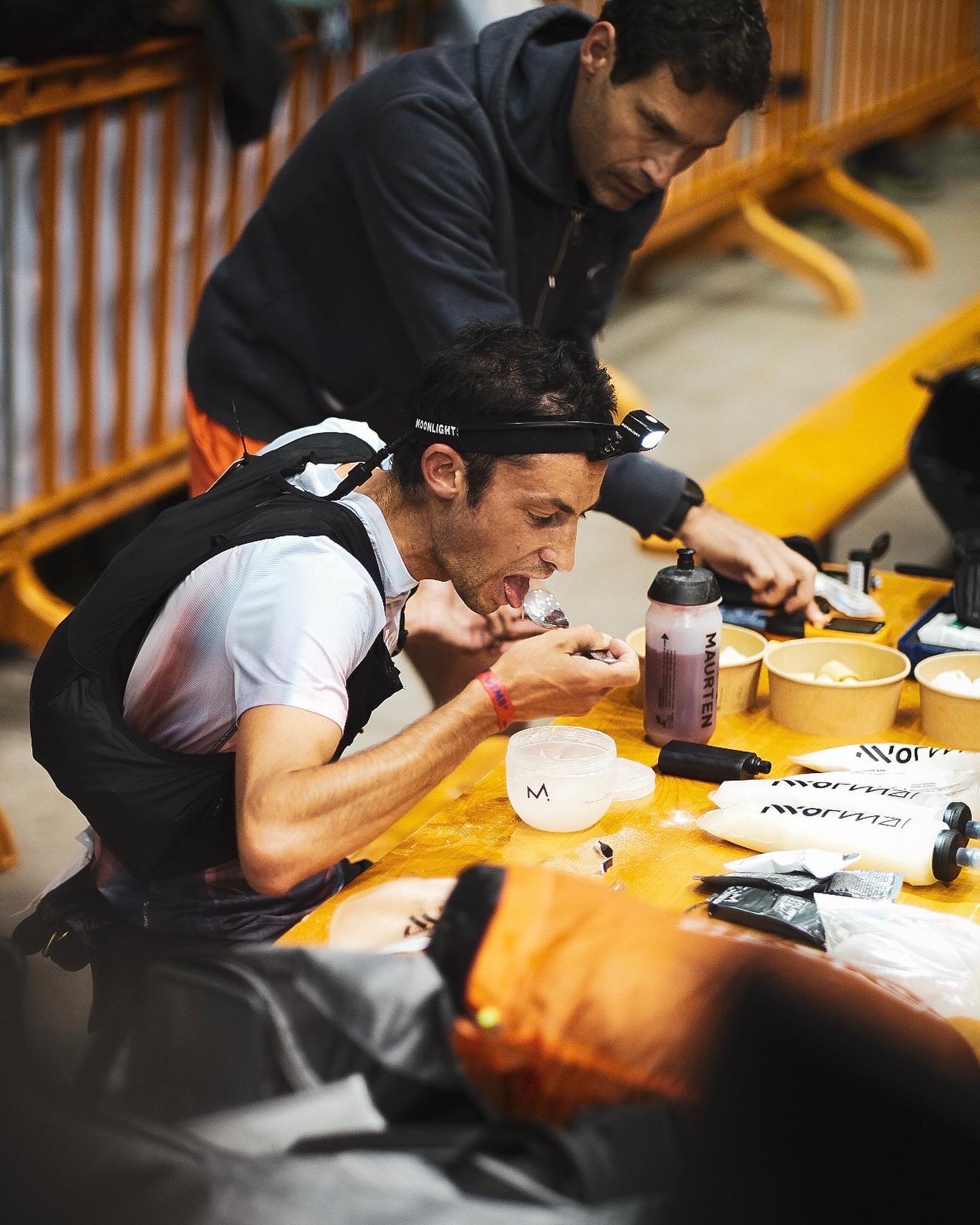
Fueling. Approximate totals: 700 gr CHO from drink; 250 gr from gels with 200 gr caffeine; from bars 160gr CHO, in solid approximately 150gr complex CHO. Homemade gel: 100gr approximately; TOTAL: 1400 gr CHO approximately with 5-6l drink water and 50-80gr protein and 80-120gr lipids. Approximately 9000 calories ingested with a loss of 14-16,000 calories.
Pupilometric assessment:

The UTMB competition produced very important levels of cognitive alteration. They are similar to patients with cranioencephalic trauma and with an important right-left relationship component. In relation to rest, the immediate post and recovery we find:
- Equilibrium 36h before competition between eyes with a tendency for the speed of dilation to be greater in the Left eye but with a better recovery time of 75% of the recovery of the basal diameter.
- 24 hours before we find an increase in the marked alteration of parameters possibly due to the activation of the SNS before the competition.
- 7′ after the arrival of the competition, a greater activation of the right eye is observed vs. On the left in time and contraction speeds. It is possible that in conditions of maximum physiological demand the organism itself activates the most altered part from a neural perspective.
- At 15′ it is found that pre-post cognitive recovery is practically total. Demonstrates a great capacity for basic cognitive balance. Surely, despite the fatigue due to the volume of exercise, there is no extreme alteration of the physiological-systemic thresholds.
Microbiota
Number of Bacteria found:

Index Shanon (diversity α)

Seasonal increase in bacterial diversity and abundance. This response can be associated with improved physical condition and dietary intervention (including probiotics). It is concluded that the best state of intestinal health coincided with the Zegama competition, subsequently existing a good basis to face UTMB and with a cushion due to the great systemic impact of the ultra race.
We believe that to finish UTMB with Covid was possible due to the good intestinal health, being much more resilient to the infection that in the previous months.


Leave a Reply to AnonymousCancel reply