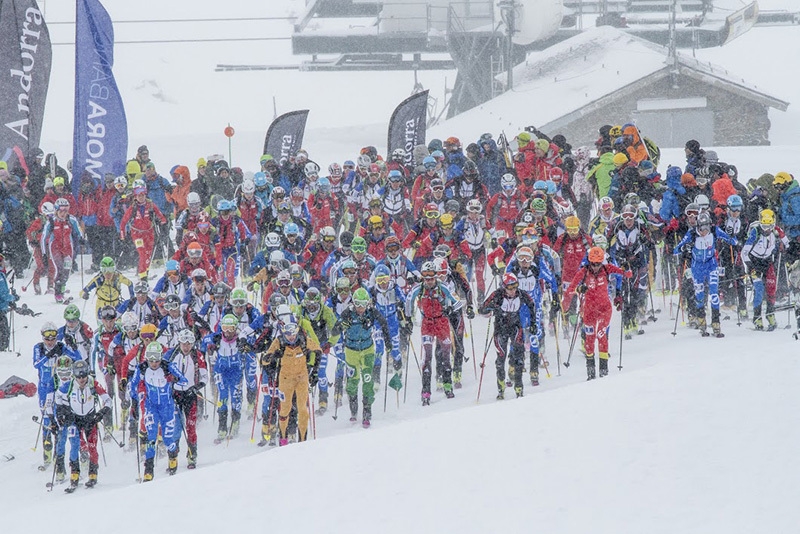

Last weekend at the start of a ski mountaineering world cup in Andorra, William Bon Mardion, a multiple times world champion was standing still at the line when the gun signed the start of the race. While the other competitors sprinted to get a good position he remained still, with his arms crossed in front of his face, as protest for the race course, that felt too artificial for competitors like him that had been in the sport for many years and seen a huge change on how the sport has evolved.
To be fair, the snow conditions in the area were difficult. There was very little snow and therefore the race was going on ski slopes instead of in the surrounding – but then green – mountains. Having been racing there world cups many years, some in great snow and some in similar conditions as this year, I can assure that the organizers probably did all they could to make the best track possible. Since 2003 when I did my first international ski mountaineering race I’ve done many races with very little snow conditions, in Trace Catalane, Albossagia, Alpago…and there’s always a nightmare for organizers and not the most enjoyable for the competitors. I don’t think the problem and why William and other racers were angry was the snow conditions and the track the organization could make but how the sport has changed in a short period of time.
Until about 20 years ago, ski mountaineering international competitions were almost exclusively team races, then it was the introduction of a individual race, witch led big protests from the athletes competing at that time, saying that it was getting away from the spirit of the sport, where mountaineers go not alone but on teams for safety. But that introduction also led to democratize the sport and nations with less tradition that couldn’t have many racers to form teams were then able to compete at a higher level. As the sport was evolving and in sight of the eventual re-inclusion of the sport in the Olympic games, the international federation introduced new disciplines that were shorter in time, more accessible for spectators and livestream teams. Since those disciplines were so short that athletes were separated by only seconds if not less, the rules – or lack of rules – that applied into the long distance races needed to get updated to not make a mess of those short distance races. With that bureaucratization of the regulations, all the disciplines got slowly transformed from an activity where lecture of the terrain, creativity and range in skillset were key into an activity where precision, repetition and speed are the dominants.
For someone like me, that grow in a sport that cherished mountain skills, it’s sad to see individual races where those capacities are no longer required and that it elongates more and more from the activity that most of the people who go ski touring does in the mountains. The pursuit of a Olympic dream as a sport is transforming the sport to fit into the schedules and requirements of it risking its own essence.
And I write that as someone who believes that disciplines like the sprint, like the vertical are giving a lot, into the visualization of the sport, to bring new people into it but also to develop skills that can be applied then in the mountains. Maybe the problem is not that those disciplines exist, but that there is a standardization of all competitions into the same model, and where the place of the most traditional disciplines, that are closer to the essence of the sport – the team races, the individuals- are getting relegated into anecdotical places in the calendar, and by inertia and the heavy regulations getting more artificialized influenced by the new disciplines.
That’s not something unique to ski mountaineering, we have seen something similar in the past with Mountain Biking, where long trails in the outdoors had been replaced for races doing loops and then loops made by artificial obstacles to bring them closer to avenues accessible to spectators and film crews.
It’s been happening also in sports climbing, where competitions started in the rock, then went into artificial structures – mostly to not benefit climbers that were living close to the crag where the competition was held – imitating rock formations so organizers could build new resembling rock routes that would be a discovery for the climbers at each competition, and then making structures that were more dynamic and spectacular but farther away from what one can find on natural rock formations.
It is also happening with trail running, where circuits in loops are getting more used to bring spectators close, to facilitate live streams, but getting away from the essence of finding the natural routes that each location had to offer, eliminating the discovery element.
I think it’s great to protest, to show discomfort when we see a sport we love to get away from the values we have been found of, but it’s more important to build, to get involved in the decisions, with the federations, the athletes associations, talking with organizers and deciders, to pass the instantaneity of a protest that would probably have a short hype in social media and instead do a constant work to keep communication with all the parts, not waiting for the changes to be too drastic to act, but to participate actively in keeping the values of the sport at the same time that is evolving.
At the end, it’s possible – and wonderful – to get excited in front of a live streaming seeing athletes fight in a 3 minutes race, get into the red pushing up a ski slope in a evening race and plan a nice ski tour in the mountains for the week end. Because if the possibilities are there and they are diverse, not by making everything to follow a same model but to embrace diversity and uniqueness, everyone could find its place in the sport.
Get involved:
Ski Mountaineering:
- ISMF has an athletes commission, those athletes should represent all the athletes inside the ISMF, bring concerns, ideas and get into the discussions of changes and regulations: http://www.ismf-ski.org/webpages/athletes-commission/commission/
- If you want to get more involved and be on that commission, there are elections for those representatives every 2 years.
- There is also a comussion of coaches, so your team coach can bring your concerns also to their representatives: http://www.ismf-ski.org/webpages/coaches-commission/commission/
Trail Running:
- The Pro trail runners association is the place where professional athletes discuss and work with the circuits and federations. If you want to get more involved you can also be part of their working groups, and every year there are board members election in the general assembly: https://trailrunners.run


Leave a Reply to Mattia MoranduzzoCancel reply