We need to eat to survive and to produce mechanical energy ( to move). Our bodies require “fuel” to produce energy and different substrates and raw materials to maintain homeostasis, repair tissues, support growth and various physical functions.

In the context of endurance sports training we often hear things like calories in equals calories out or the importance of gut training to get more calories in during training and racing. There are some caviats to that. Our body is not a motor that converts food as fuel to mechanical energy as a simple process.

In the gross part, this energy comes from the oxidation of carbohydrates, fat and protein (there are other pathways on lactate, ketone bodies, reactive oxygen species, SCFAs from fiber fermented via bacterias, butyrate, acetate, propionate…). That substrate comes from the food we ingest or the substrates we have stored in our body (fat and glycogen in liver and muscles mostly) and serves to maintain functions and to move our muscles. According to the first law in thermodynamics, energy can’t be created or destroyed, therefore we need to match our calories intake to our power output, either eating them or using the substrates on and in our body, something that is not sustainable in the long term. Also because if the body is in a catabolic state it will prioritize survival and “protect” some systems in detriment of performance.

But not all we eat is directly converted to be used by mitochondria to move our muscles. There is what we are able to eat ( nutrient intake) versus what we can absorb ( the role of microbiota, hormonal – tiroids- functions) and oxydation capacity ).

The most we are able to spend (Increasing our capacity of expenditure – ↑ mitochondrial capacity, ↑ oxidation capacity etc. ) means also that we are able to produce more mechanical energy, and to utilize more of the substrate we eat.

The total Daily Energy Expenditure (TDEE) is comprised of several layers, but the two most fundamental metrics for assessment are Resting Metabolic Rate (RMR) and the Physical Activity Level (PAL).

1. Resting/ Basal Metabolic Rate (BMR)

BMR is the energy required to maintain essential physiological functions (like breathing, blood circulation, and cell production) while the body is at rest.

  • It can be estimated via formulas like the Mifflin St Jeor or Cunningham equations, via analyze of gas exchange (o2 and co2) while resting, or directly in a calorimeter. Is important to take into account that the RMR will not be always the same and will have variations every day.
  • Since muscle tissue is more metabolically active than fat, athletes typically have a higher BMR than sedentary individuals of the same weight.

2. Physical Activity Level (PAL)

PAL is a ratio used to express an individual’s total energy expenditure relative to their BMR.

  • PAL = Total Daily Energy Expenditure​ ÷ Resting Metabolic Rate
  • A sedentary person usually has a PAL of 1.2–1.4. In contrast, elite endurance athletes during heavy training blocks can reach PAL values of 2.5 to 4.0 or higher.
  • The TEE is the Physical Activity Energy Expenditure (PAEE): the energy cost of exercise. + the Thermic Effect of Food (TEF): energy required for digestion and metabolism. Sometimes if the stimuli has been big our consumption is elevated for a time post exercise, we should account for that too.
  • It’s hard to calculate or estimate the total energy expenditure. During sport it’s easier, looking at the kilojoules of work and the efficiency, but the non BMR and non Training expenditure might variate a lot, that’s the one from daily tasks, if we move a lot, if we have kids and play with them, if we have a physical work, the mental / cognitive tasks, etc.
  • Also of we count the calories we ate and our weight it’s many factors that might introduce error. First from food, every aliment and between the same aliment has different calories (rice boiled with more or less water, a banana more or less mature…) and weight might be affected by water retention from inflammation or sodium intake, the loading of glycogen in muscle or liver, etc.
  • To calculate the TEE there are also different ways, estimations from gas exchange or directly on a calorimeter or with double labeled water (DLW).

How much do we spend?

In recent years the research on PAL / TEE has increased with easier methods to measure-it. In a 2024 study by Olav Alexander Bu they measured Kristian Blummenfelt PAL during training weeks at around 3,6-3,8. More recently a year-long study in professional cyclists by Bas Van Horen & Co they saw that even if TDEE could be big on short periods of time, over the course of a year it tends to stabilize around the 2,5 PAL mark.

From Bas Van Horen study

Single Event Limits (Acute)

In short-term events (lasting hours to a few days), humans can reach incredible metabolic peaks because they are “burning through” stored energy (glycogen and body fat).

  • The Peak: Research on Ironman triathletes and ultra-marathoners shows metabolic scopes can hit 9.4× BMR for a single day (Thurber et al., 2019).
  • Recorded Extremes: Participants in the 24-hour Western States Endurance Run have recorded expenditures exceeding 16,000 kcal in a single day.

Sustainable Limits (Chronic)

As the duration of an event increases (weeks to months), the maximum energy expenditure we can maintain drops and eventually plateaus.

The alimentary limit is suggested in a landmark study by Thurber and Pontzer (2019) published in Science Advances analyzed data from the “Race Across the USA” (a 140-day run) and found a metabolic ceiling around 2,5 PAL.The study suggested that this limit is highly dictated by the digestive tract. Our guts simply cannot absorb nutrients fast enough to sustain an expenditure higher than that ceiling indefinitely. Beyond this point, the body begins to consume its own tissues to bridge the gap.

Is important to keep a sustainable TEE/intake for:

  1. Avoiding RED-S: If an athlete consistently exceeds their sustainable limit without adequate intake, they enter a state of Relative Energy Deficiency in Sport (RED-S). This leads to hormonal disruption, bone density loss, and decreased protein synthesis.
  2. Systems disruption: Research suggests that the body may “compensate” for high activity by lowering energy spent on other systems (like immunity or repair). Athletes must fuel adequately to ensure the body doesn’t “steal” energy from vital processes to power their training.

A thing that in my opinion is important to understand when we are talking about energy expenditure is how do we create this “capacity of expenditure”. To be able to spend we need to be able to absorb the substrates (eat and digest), to oxidize those substrates (convert the food into energy to be used by muscles) and also to have access to the substrate (have access to food or to have internal reserves of fat, glycogen in the most part), in that order:

  1. Create capacity (oxidation, multiple pathways simultaneously)
  2. Ensure absorption (digestive capacity)
  3. Give opportunity (Substrate availability)

The problem is that most people reverse the order of that. They have big access to food and they train with big amounts of intake to increase their absorption capacity BEFORE creating a capacity to oxidize those substrates, making that they are able to eat a lot but not to utilize that food. That not utilized substrate can either get down in the toilet or get transformed and cumulated in the body as fat, but can also it make an increase of “useless” gastric work that can derive in cases to inflammation, and if it gets chronic into dysbiosis and permeability. Therefore, in my opinion, we need first to train to increase our capacity, increasing the amount of mitochondria and its efficiency, and have a good flexibility in all the different pathways so we can “burn” different substrates at the same time. Also ensure we have a good microbiota that makes the digestion and absorption of the nutrients we ate and a good hormonal ( specially tiroid) balance. And then, seeing what our oxidation capacity is, to work in the digestion capacity and ensure we have substrate availability.

Measures in Trail and Mountaineering events:

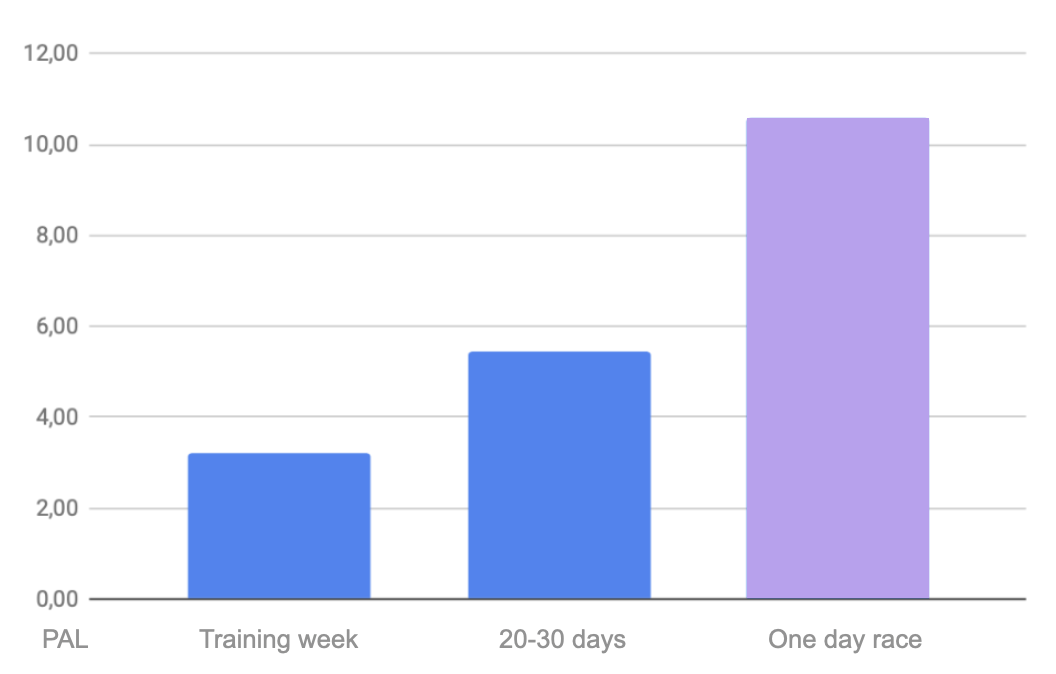
In the past years I have been doing some measurements with DLW (Calorify) in different scenarios. A volume training week, during a long project (Alps 4000ers, US 14ers) and in a one day competition (Western States).

In the first case (training week) My weight was stable and it felt sustainable to keep this ratio for a long period. In the 2nd case, lasting 19 and 31 days, my weight was also stable and I could measure metabolic improvements after that period, but my neuromuscular capacity was degrading, so even if from a Gastrointestinal absorption of nutrients and a effort capacity it seem sustainable, the neuromuscular decrease would eventually make it unsustainable. In the last case, during a 14h race, I lost 4.3% of my weight. That mostly came from a pre-load I did before the race of 2,5kg of weight (cumulated fat during previous 10 days, cho stored and water retention the days before the race) and finishing the race at my pre-load weight.


23 responses to “Energy Expenditure”

  1. Marc Avatar
    Marc

    By multiple pathways you mean ingesting water with olive oil for example, correct? I have been trying this as well with good success on runs up to four hours so far. Do you use a particular ratio of carbs to fat(for example, 2 flasks of carbs and 2 flasks of olive oil in 4 hours of training)?
    Thank you for your post!

  2. Kilian Jornet Burgada Avatar
    Kilian Jornet Burgada

    Multiple pathways means that depending the demands of the moment we will use different ways to obtain that energy ( from phosphocreatine, lactate, carbs – fructose and glucose- fat, butyrate, etc. The “training” of the pathways are not by ingesting but by training at intensities and with substrates that prioritize those pathways. Then when we know that we are able to oxydize those substrates we can look at how much and the substrate distribution of that much. If not we are creating a digestion adaptation without an oxydation capacity…

    1. Marc Avatar
      Marc

      Yes, thank you for clarifying this! Will you perhaps write a subsequent post about how you determine adequate oxydize capacity and substrate distribution?
      Thank you, very helpful to me.

      1. Kilian Jornet Burgada Avatar
        Kilian Jornet Burgada

        If you want to be somewhat precise you can do it with an isotopes test and a O2-CO2 analyser.

      2. Marc Avatar
        Marc

        Again, thanks for this Kilian. I will look into that.

  3. DavidOrti Avatar
    DavidOrti

    Hi Kilian, thanks for the post. Very insightful! Nevertheless, I feel like I’m missing something.

    You mention that the development direction must be capacity > absorption > substrate. While at the same time, RED-S like conditions should be avoided. To me, we’re navigating along the limit of just eating what you spend? Or are there different approaches during the season…

    Also, in the case of fats, the biggest source for long events, are the storages as available as intake? I wonder how useful it is to consume them during activity. Whats your experience here?
    Gracias!

    1. Kilian Jornet Avatar
      Kilian Jornet

      Yes that’s why is important to have a good assessment of the energy expenditure. If not many times we will under fuel. Then in how we ate and the timing on it we need to ensure that we are able to absorb and utilize what we eat, if not we will eat a lot but not absorb and utilize those substrates, and therefore, even if we overeat we can have energy deficiencies or other problems while not being able to utilize the substrate we ate.

      Specific for fats in long events, we need to see how much we will spend and how much of that will come from fats and cho, and then make a plan. In general we have plenty of fat stored already, but if we will have big demands where cho oxidation isn’t enough and we don’t want to have a big deficiency during the event so our system turns into a “saving” mode that can alters our physiological or hormonal response (something natural where the body in prevision of scarcity will slow down or alter some systems for survival vs to maximize performance) then IMO eating fats during exercise is a great source of energy too. For that we need to train the fat absorption during exercise to ensure we can absorb those and not have GI issues.

      1. DavidOrti Avatar
        DavidOrti

        Good angle, I have the feeling athletes pay a lot of attention to whats actually being used, so then we can fuel accordingly. Maybe a gas test is a first step to understand that. I have mine scheduled soon. Thanks Kilian!

      2. Marc Avatar
        Marc

        To that end how would you suggest one train the fat absorption during exercise? Also, do you still think there is a place for “fasted” training sessions or is this too high of a risk of the catabolic state?

  4.  Avatar
    Anonymous

    HI Kilian,
    Could you please explain a bit more in details how do you do that in practice ?
    “Therefore, in my opinion, we need first to train to increase our capacity, increasing the amount of mitochondria and its efficiency, and have a good flexibility in all the different pathways so we can “burn” different substrates at the same time”
    and “The “training” of the pathways are not by ingesting but by training at intensities and with substrates that prioritize those pathways.”

    And last question, what is the goal of eating fat during an effort like Wser? We have enough fat store to get sufficient energy. Is it because you found fat intake helps you to keep fat ox higher ?

    Thanks a lot !

    1.  Avatar
      Anonymous

      I am Alexandre (I can’t not change “Anonymous” !)

    2. Kilian Jornet Avatar
      Kilian Jornet

      In a race like western you could see that energy expenditure was 16000cal. I could eat and oxidize a small amount of that from cho, another come from fat stored, but to not enter on a catabolic mode during the race I wanted to have the minimum possible loss of weight / cal during the race therefore the add intake of fat during the race, so I could be absorbing xgr from cho and x from fat during the race for that

      1. Alexandre Avatar
        Alexandre

        This is what I read in the other comment but would like to be sure it was not link to fat ox during the race. It makes sense to reduce the caloric deficit as much as possible. Have you found a difference in terms of performance when your reduce this acute deficit or only on your heal to and recovery ?
        No scientific paper on this right now I guess, but Lois Mougin studies on you this year will probably give us some details and data to look at.
        I reached to you in Limbus press to ask you if you could be interesting to register an episode on my podcast with me (Alexandre Auffret). I gave you more details in the email, but could also be interesting to speak about this article too. Unfortunately a lot of time people think of you as the guy who trained without eating. They do not speak about the big picture and all you do is focus on your health first, this is why you have been able to perform at this incredible level through the years… it’s the right message to share, thanks Kilian !

      2.  Avatar
        Anonymous

        Hi Kilian,
        I recently reached out via Lymbus Press but wanted to share my request here as well:

        “I’m Alexandre Auffret, a physiotherapist and host of the French podcast “Tout pour ma santé” (focus: science-based health & performance). I live near Canigou, not far from your child home !

        I’d love to invite you for a “Geek & Health” conversation—not a race report, but a deep dive into your self-coaching philosophy and how amateurs can apply your approach while prioritizing health and longevity.

        Topics I’d love to explore:

        – Why you spend so much time in Zone 1 (and why amateurs get this wrong)
        – How you monitor internal load and manage inflammation
        – Your experiments with gut health, nutrition, and metabolic flexibility
        – Training with passion and trusting your plan
        – Health vs. performance: “Being a pro ultra runner is unhealthy” (I disagree!). What is your opinion on this ?
        – NNormal’s approach to shoe innovation (if you’re open to it)

        The interview would be in French, remote via Riverside, and flexible in duration.

        Thank you for your inspiration and contribution to sport science!
        Alexandre Auffret
        Podcast: https://toutpourmasante.fr/podcast-tout-pour-ma-sante/

  5.  Avatar
    Anonymous

    Thanks a lot for the “food for thought”, Kilian! Interesting, as always! Do you know of any pragmatic approaches (e.g. measurement methods and training protocols) that can be used by non-elite athletes without access to costly equipment?
    Thanks again, Florian

  6.  Avatar
    Anonymous

    Hi Kilian,

    Thank you for the post. Could you tell me what a normal training week looked like when you had a PAL of 3,21? Just to get a better understanding of the caloric expenditure in relation to the volume of training.

    1. Kilian Jornet Avatar
      Kilian Jornet

      It was in march – a Aerobic / base training week, 25h of exercise

      1.  Avatar
        Anonymous

        Thank you! Was that only running or biking as well? Any idea on the distance covered and/or power output?

      2. Kilian Jornet Avatar
        Kilian Jornet

        DLW measures TEE, so all energy expenditure in a done period of time. So in that case all energy expended during a week, that includes the one during training, but also the BMR, the other daily activities (playing with kids, walking, etc etc)

      3.  Avatar
        Anonymous

        Got it! Any idea on what those 25h of exercise consisted of? And also how active you were outside, perhaps number of steps/day?

  7. Lorenzo Avatar
    Lorenzo

    Does this mean adaptation by e.g. high volume-low intensity workouts whilst fasted? Training in zone 1-2 whilst fasted will enable fat to be used as fuel. Training at higher intensity 3-4 over a long duration whilst fasted will trigger a different metabolic pathway and consumption of glycogen, where there is a limited supply (hence ultimately bonking/hitting the wall).

  8.  Avatar
    Anonymous

    You are on the right path Kilian. For sustaining a life of high level performance based activities one needs to build what I term as “Metabolic Capacity” which, as you allude to, is building mitochondria and mitochondrial function. This is achieved by optimizing fat based metabolic pathways…..not solely for energy but, as importantly, because it is via fat/lipid metabolism that our bodies are built upon.

    Glucose is simply an energy source whereas fat metabolism plays several roles in metabolic health & performance.

    Because of this complex role of fat metabolism it is not well studied because it is difficult to isolate via scientific method. For building metabolic capacity for both performance and health, one has to look at the body as a biological system. This means approaching this holistically and comprehensively. Physical activities of all modalities from HIIT to long duration aerobic activities (like roaming in the mountains all day) to resistance/strength work….all play crucial roles and signal different aspects of adaptation crucial for building metabolic capacity. In conjunction with this adequate rest and downtime for recovery….this is where the ‘magic’ happens of adaptation / hormesis / training effect / supercompensation.

    Carbs actually play a crucial role for performance level fat adaptation. Without them to drive glycolytic pathways at higher levels one cannot ‘push’ to get the adaptive signalling necessary for the adaptations that drive higher performance level fat metabolism. Unfortunately those in the keto / Low Carb camp do not want to acknowledge this key shortcoming…i.e. that Keto or LCHF limits performance…….

    The complete restriction of dietary CHO intake limits optimization of both health and performance. Similarly, overconsumption of concentrated forms of CHO has a host of ‘unintended consequences’ which, over time, seriously impact health. For endurance athletes it typically begins as GI issues but this has other subtle and not so subtle impacts on health and immune/autoimmune function (non-starchy vegetables do not count as CHO because of how they are digested….they actually are converted to short chain fats in the colon by our biome).

    Similarly, when one is performance level fat adapted, high level fat adaptation when done with carbs as a key tool, supports glycolytic pathways for competition. Not only does this spare glycogen and the need for these crazy high levels of CHO ingestion some elites are doing, but by being fat adapted the liver is able to convert liver fat into a considerable stream of glucose via gluconeogenesis to support sustained use of glucose when demands are high. In addition the increase in aerobic capacity necessary for high level fat oxidation (>1.25g/min) supports super high levels of aerobic glycolysis when necessary without spilling into anaerobic glycolysis (remember that it requires 2X the Oxygen per ATP via beta-oxidation versus aerobic glycolysis).

    Point is this topic is nuanced, contextual and multivariate. The science is exceedingly complex due to this, however, the actual execution is relatively easy and natural when one uses our evolutionary heritage as a guide.

    1. Peter Adrian Defty Avatar
      Peter Adrian Defty

      I did not mean to be anonymous so here I am ‘outing’ myself here.

Leave a Reply to DavidOrtiCancel reply

This site uses Akismet to reduce spam. Learn how your comment data is processed.

Latest Articles

Discover more from mountain athlete

Subscribe now to keep reading and get access to the full archive.

Continue reading