
We need to eat to survive and to produce mechanical energy ( to move). Our bodies require “fuel” to produce energy and different substrates and raw materials to maintain homeostasis, repair tissues, support growth and various physical functions.
In the context of endurance sports training we often hear things like calories in equals calories out or the importance of gut training to get more calories in during training and racing. There are some caviats to that. Our body is not a motor that converts food as fuel to mechanical energy as a simple process.
In the gross part, this energy comes from the oxidation of carbohydrates, fat and protein (there are other pathways on lactate, ketone bodies, reactive oxygen species, SCFAs from fiber fermented via bacterias, butyrate, acetate, propionate…). That substrate comes from the food we ingest or the substrates we have stored in our body (fat and glycogen in liver and muscles mostly) and serves to maintain functions and to move our muscles. According to the first law in thermodynamics, energy can’t be created or destroyed, therefore we need to match our calories intake to our power output, either eating them or using the substrates on and in our body, something that is not sustainable in the long term. Also because if the body is in a catabolic state it will prioritize survival and “protect” some systems in detriment of performance.
But not all we eat is directly converted to be used by mitochondria to move our muscles. There is what we are able to eat ( nutrient intake) versus what we can absorb ( the role of microbiota, hormonal – tiroids- functions) and oxydation capacity ).
The most we are able to spend (Increasing our capacity of expenditure – ↑ mitochondrial capacity, ↑ oxidation capacity etc. ) means also that we are able to produce more mechanical energy, and to utilize more of the substrate we eat.
The total Daily Energy Expenditure (TDEE) is comprised of several layers, but the two most fundamental metrics for assessment are Resting Metabolic Rate (RMR) and the Physical Activity Level (PAL).
1. Resting/ Basal Metabolic Rate (BMR)
BMR is the energy required to maintain essential physiological functions (like breathing, blood circulation, and cell production) while the body is at rest.
- It can be estimated via formulas like the Mifflin St Jeor or Cunningham equations, via analyze of gas exchange (o2 and co2) while resting, or directly in a calorimeter. Is important to take into account that the RMR will not be always the same and will have variations every day.
- Since muscle tissue is more metabolically active than fat, athletes typically have a higher BMR than sedentary individuals of the same weight.
2. Physical Activity Level (PAL)
PAL is a ratio used to express an individual’s total energy expenditure relative to their BMR.
- PAL = Total Daily Energy Expenditure ÷ Resting Metabolic Rate
- A sedentary person usually has a PAL of 1.2–1.4. In contrast, elite endurance athletes during heavy training blocks can reach PAL values of 2.5 to 4.0 or higher.
- The TEE is the Physical Activity Energy Expenditure (PAEE): the energy cost of exercise. + the Thermic Effect of Food (TEF): energy required for digestion and metabolism. Sometimes if the stimuli has been big our consumption is elevated for a time post exercise, we should account for that too.
- It’s hard to calculate or estimate the total energy expenditure. During sport it’s easier, looking at the kilojoules of work and the efficiency, but the non BMR and non Training expenditure might variate a lot, that’s the one from daily tasks, if we move a lot, if we have kids and play with them, if we have a physical work, the mental / cognitive tasks, etc.
- Also of we count the calories we ate and our weight it’s many factors that might introduce error. First from food, every aliment and between the same aliment has different calories (rice boiled with more or less water, a banana more or less mature…) and weight might be affected by water retention from inflammation or sodium intake, the loading of glycogen in muscle or liver, etc.
- To calculate the TEE there are also different ways, estimations from gas exchange or directly on a calorimeter or with double labeled water (DLW).
How much do we spend?
In recent years the research on PAL / TEE has increased with easier methods to measure-it. In a 2024 study by Olav Alexander Bu they measured Kristian Blummenfelt PAL during training weeks at around 3,6-3,8. More recently a year-long study in professional cyclists by Bas Van Horen & Co they saw that even if TDEE could be big on short periods of time, over the course of a year it tends to stabilize around the 2,5 PAL mark.

Single Event Limits (Acute)
In short-term events (lasting hours to a few days), humans can reach incredible metabolic peaks because they are “burning through” stored energy (glycogen and body fat).
- The Peak: Research on Ironman triathletes and ultra-marathoners shows metabolic scopes can hit 9.4× BMR for a single day (Thurber et al., 2019).
- Recorded Extremes: Participants in the 24-hour Western States Endurance Run have recorded expenditures exceeding 16,000 kcal in a single day.
Sustainable Limits (Chronic)
As the duration of an event increases (weeks to months), the maximum energy expenditure we can maintain drops and eventually plateaus.
The alimentary limit is suggested in a landmark study by Thurber and Pontzer (2019) published in Science Advances analyzed data from the “Race Across the USA” (a 140-day run) and found a metabolic ceiling around 2,5 PAL.The study suggested that this limit is highly dictated by the digestive tract. Our guts simply cannot absorb nutrients fast enough to sustain an expenditure higher than that ceiling indefinitely. Beyond this point, the body begins to consume its own tissues to bridge the gap.
Is important to keep a sustainable TEE/intake for:
- Avoiding RED-S: If an athlete consistently exceeds their sustainable limit without adequate intake, they enter a state of Relative Energy Deficiency in Sport (RED-S). This leads to hormonal disruption, bone density loss, and decreased protein synthesis.
- Systems disruption: Research suggests that the body may “compensate” for high activity by lowering energy spent on other systems (like immunity or repair). Athletes must fuel adequately to ensure the body doesn’t “steal” energy from vital processes to power their training.
A thing that in my opinion is important to understand when we are talking about energy expenditure is how do we create this “capacity of expenditure”. To be able to spend we need to be able to absorb the substrates (eat and digest), to oxidize those substrates (convert the food into energy to be used by muscles) and also to have access to the substrate (have access to food or to have internal reserves of fat, glycogen in the most part), in that order:
- Create capacity (oxidation, multiple pathways simultaneously)
- Ensure absorption (digestive capacity)
- Give opportunity (Substrate availability)
The problem is that most people reverse the order of that. They have big access to food and they train with big amounts of intake to increase their absorption capacity BEFORE creating a capacity to oxidize those substrates, making that they are able to eat a lot but not to utilize that food. That not utilized substrate can either get down in the toilet or get transformed and cumulated in the body as fat, but can also it make an increase of “useless” gastric work that can derive in cases to inflammation, and if it gets chronic into dysbiosis and permeability. Therefore, in my opinion, we need first to train to increase our capacity, increasing the amount of mitochondria and its efficiency, and have a good flexibility in all the different pathways so we can “burn” different substrates at the same time. Also ensure we have a good microbiota that makes the digestion and absorption of the nutrients we ate and a good hormonal ( specially tiroid) balance. And then, seeing what our oxidation capacity is, to work in the digestion capacity and ensure we have substrate availability.
Measures in Trail and Mountaineering events:
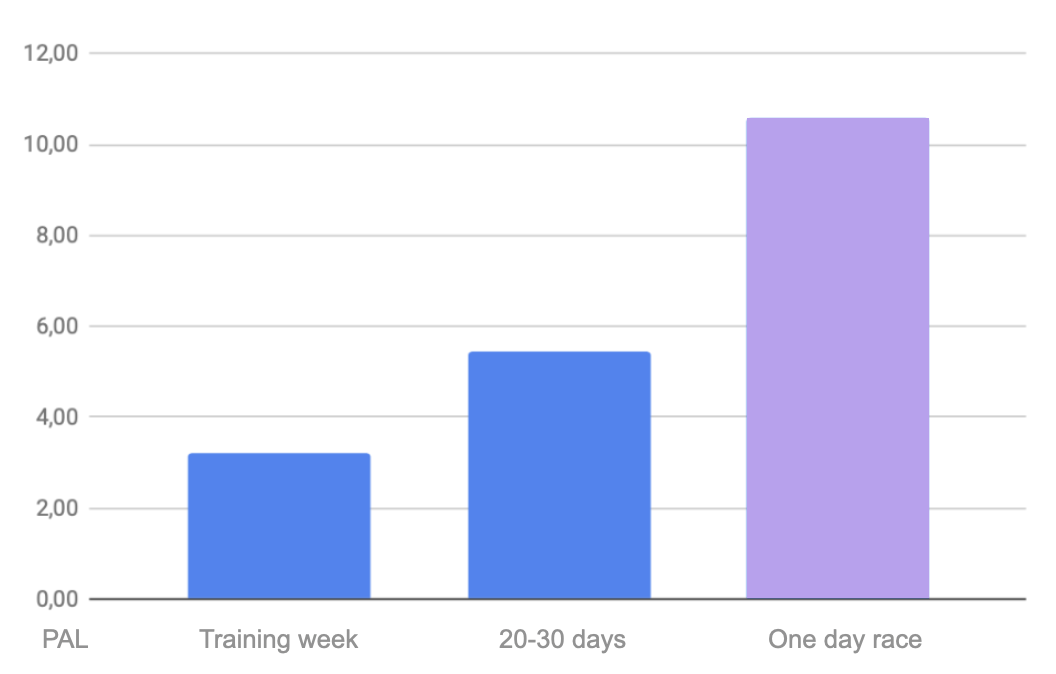
In the past years I have been doing some measurements with DLW (Calorify) in different scenarios. A volume training week, during a long project (Alps 4000ers, US 14ers) and in a one day competition (Western States).

In the first case (training week) My weight was stable and it felt sustainable to keep this ratio for a long period. In the 2nd case, lasting 19 and 31 days, my weight was also stable and I could measure metabolic improvements after that period, but my neuromuscular capacity was degrading, so even if from a Gastrointestinal absorption of nutrients and a effort capacity it seem sustainable, the neuromuscular decrease would eventually make it unsustainable. In the last case, during a 14h race, I lost 4.3% of my weight. That mostly came from a pre-load I did before the race of 2,5kg of weight (cumulated fat during previous 10 days, cho stored and water retention the days before the race) and finishing the race at my pre-load weight.




Leave a Reply to Kilian Jornet BurgadaCancel reply