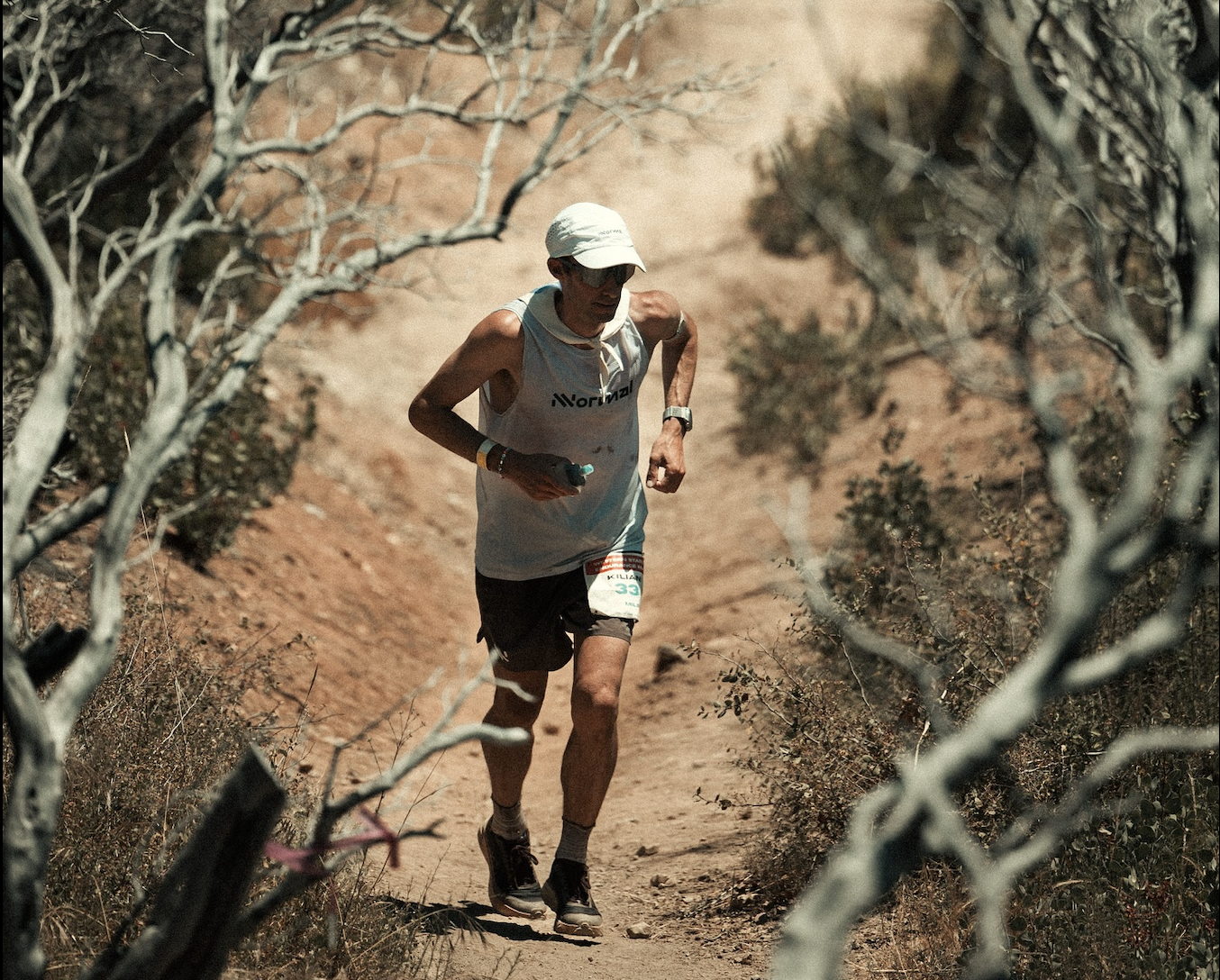

I will try to explain how I trained and raced Western States Endurance Run where I finished 3rd with a time of 14h19 minutes.
Even if we like to get insights from the specific training, reality is that to build fitness is about long term. Here a shoot of my training volume over the past 16 years, as you can see, even if important to adapt for the race conditions, the capacities acquired during this training block are a very small part of what it takes to build fitness. It’s also important to understand that the training buildup as well as the race strategy is highly dependent on individual, capacities and adaptions, therefore it’s important to plan accordingly to your own needs and individual systems and not to copy those from other athletes. If you want to know more about my training approach you can read it in the page TRAINING.

Why Western States after 14 years?
Western states is probably one of the last trail races I would choose only for its course and conditions. Probably that is why I wanted to do it, because it doesn’t fit me and that’s why is it exciting to train for.
Last year I did some of my best performances in short trail running races, winning Zegama, Sierre Zinal with a course record and doing my best times in all my uphill training routes.
In the end of the summer I did one of coolest projects I have ever done connecting all the 4000ers of the Alps.
Since some years I feel that I don’t have a “bucket list” of races I want to do or win, but what motivates me to stay in competition is to find races where level is high and I know that I will need to train very well to perform, and where training and preparation is a challenge and something that it motivates me to try new approaches to it.
With that, after last year project in Alps I started to think about what to do this season. On a way I felt that I wanted to do something different than last years, 2022 was mostly about doing short-ultra-short-ultra, 2023 It was mostly about mountaineering projects (Romsdal, Himalaya, Pyrenees) and 2024 about short distance and the Alps. So it felt natural to think about doing long distance. There is not many ultras with a high density of competitors and among them probably the one less adapted to my qualities is Western States 100. Last year, 3 of my friends and training mates from Romsdal, Ida, Petter and Jon did the race and I got pretty re-inspired to do this race that I did back in 2010 and 2011. Since then trail running has changed a lot, we have much better knowledge, access to better equipment for cooling and fueling and the specific preparation for races has deeply evolved. Also the field of athletes at wser is always well packed and this year seemed to have an even higher density of elites registered. With that I thought it would be fun to race again there after so many years.
To entry the race I needed to do a qualifier race. There are not many golden ticket races in Europe and basically my chances were to be racing at Chianti ultra, a 120k race in Italy in the end of March. Normally at that period of the year I’m doing my base building, mostly on skis, but started to do some running earlier to have some in my legs.
That basically translated on doing a few runs – in the treadmill during the first months and outside on roads when the snow started to melt down – every week and one speed session per week.
Those speed sessions lead to a TFL tendonitis. At the beginning I thought it was just a glute over activation that would disappear when I getting more used to running so I kept doing the sessions, which was a mistake since the pain not only didn’t decreased but get more acute. I started then visiting my physiotherapist, Lars Håvard Sæbø, once a week to do massage and some times needles. I reduced the total running and introduced more biking in the training, keeping the running to have a minimum to arrive at Chianti.
Being injured I went to the race at Chianti with many doubts. I thought that I had the capacity to get the golden ticket but I wasn’t sure I could finish the race. With Jim Walmsley and Vincent Bouillard I knew that they would be in front and I needed to run faster than the next runner but the slowest possible so the injury permitted me to finish the race. At the end I got the Golden Ticket with a 2nd position but the pain after the race in my knee was severe.
I took 3 full weeks without running, only cycling to reduce the knee inflammation, and kept working with Lars Håvard to continue the TFL tendonitis recovery.
Training for Western States from Norway:
With Jesus Alvarez-Herms we worked on a plan to prepare for Western States.
I needed to improve basically 2 things: Economy and neuromuscular adaptions in a “flattish” terrain for long distance and adapt to heat.
For most of my career I have been heavily struggling on heat conditions. I sweat very little and can handle long periods of time exercising without water, witch has it’s interest in long activities without water availability but when exercising on warm environments it meant that my body was just overcooking before starting to put in place cooling mechanisms. In the past year I started doing some heat training and seen great improvements, so I was somehow confident that it would be possible to prepare for the race doing heat training while living in Norway.

Bloc 1: 3 weeks: The goal was to start adaptions, doing heat training sessions every 2nd day -2h sessions on the bike- and then a long run at easy terrain and elevation ration similar to western states the other day at around 4’/km pace. The alternate days running-biking was also good to let the knee recover after every day running.
Bloc 2: 5 weeks: I kept the same scheme, with 3 long runs of 3h and around 40km alternated with heat training sessions, 2 about 2h bike and 1 of 2h biking and 1h running or 2h running.
Bloc 3: 3 weeks: One long run per week (80km, 6h – 80km, 6h – 60km, 4.5h) to do a bit more neuromuscular work and simulate race nutrition, gear… then some other runs when feeling recovered, kept 4 sessions of 2h of heat training per week.
Temperatures in Norway at that period of the year – and almost all year – rarely exceed 20ºC, most of the days were from 0º to 10ºC, therefore the heat sessions were done indoors. I heated the gym home at 40ºC and was doing low controlled steady effort. Pulse was in general between 100 and 120 ppm. The goal was to reach 38,5-39ºC core temperature (measured with rectal thermometer) and stay there for 1,5 to 2,5h depending the session.
One interesting thing is that despite not doing any intensity and interval training – only running some uphills during my long runs at threshold pace – my performance level at short uphills improved from the previous years when I did much more specific training. That is probably due to the biological inertia of training, The cellular tendency to maintain their migration direction for some time even when a stimulus/environment has been reversed if the stimulus/environment has been previously persisted for a long period.
Another great adaption was that with the succession of long runs, the muscular adaptions were clear. If in the first week I would feel some legs discomfort the day after a 40k run, at the end of the block, even the day after a 80k run my legs muscles were fine. That also translated well to recover from WSER, since the day after the race I had not any pain on my quads, just a bit stiff hamstrings – but swallow feet and one annoying blister under one feet due to some sand that entered at some point.
During this build up the pain on the knee disappeared completely when I was running but the day after any run I felt it at some degree, something that comforted me
Then I did one week of tapering when I traveled and ran the Broken Arrow ascent. That week kids were sick at home and I thought/hoped I would not get it but with the stressor and conditioned air from the travel I arrived at US sick. I wasn’t too worried of the cold for Western Stated because normally the cold last 3-4 days but with the dry air compared to Norway the mucous kept pretty heavy til the race.
Race strategy and execution:
Nutrition and hydration:
The last 2 weeks leading to the race I increased my body weight for about 1,5-2kg. Mostly increasing my fat mass and water. That was to have some extra calories and water in the tissues, because it would be impossible to eat during the race the amount of calories I would expend, and as I was pretty thin during my training blocks, I didn’t had much on reserve at that point.
I woke up at 3 AM, 2h before the race start and ate a bowl of overnight oats with berries and honey. I also drank 0,5L of water and took probiotics (3 sachets of Lyvecap – 2400 billion CFU)
The race can be divided in 3 main sections, the high country, the canyons and the savanna. The goal in nutrition plan was to get enough energy for the effort avoiding having GI issues, specially with the race demands with altitude and heat for so many hours.
During the first hours at altitude, cold temperatures and freshness in the body I kept the GI system with low activity, eating a 50%fat-50%cho mix (avocado, coconut oil, nuts, dates, banana, overnight oats, cacao, beetroot) with big intakes (2000 cal in 3 intakes) but distanced in time – 2-3-4h in the race. The hydration at that point was about 0,5l/h with 1,5gr of sodium per liter.
In the 2nd part of the race, in the Canyons, with temperatures rising and more elevation gain I increased the fluid to 1 liter/hour with same sodium concentration and was eating solid (complex carbs in jelly’s or soft bars) in the downhills and gels (Maurten 160) in the uphills. Intake here was every 30 minutes, and average ratio was mostly 60-80 gr/cho/h and some fat.
In the last part, in the savanna from Foreshill to the finish I was switching to purely carbs, with gels in a flask (Maurten 160) with intakes every 30 minutes of 55gr (110gr/cho/h). I kept the fluid intake of 1L/h with 1.5gr of sodium.
During the race I was peeing quite a few times, hydration was good as the pee was clear and in quantity. I preferred to keep drinking a bit more than what was probably necessary to help cooling and to absorb better the nutrients I ate.
The GI system was great during all the race. at the last stages when I wanted to increase the intake it was not problem and not any discomfort for it, and my energy levels during the race were stable all long and I was able to increase intensity in the last part.
In total I consumed 6160 calories during the race and drank 12,5 L of water. My weight loss was of 2,5kg during the race.
/ I did a double labeled water test during the race to see the exact expenditure during the race. I will upload the data when I get the results /

Cooling strategy:
Temperatures during the race were very warm, above the average on the race, going up to 38ºC-100ºC in the lower sections. I believe the heat training and cooling strategies worked very well since it was the first race in hot conditions I’ve done where I didn’t suffered heat and during the race I never felt it was that hot. From the first crew point at Duncan Canyon I started with cooling. I had a cap with a PVA band sewed inside to keep humid and cooler for longer periods, and I was changing cap at every crew aid station and putting water on them in the oder aid stations and rivers. I had a bandana on my neck that I was filling with ice at every aid station. I had 2 teeshirts I was sweeping at the crew stations to be cold and wet. When it was a river I was sitting – lying on it for 10-20 seconds, to cool all my body.
/ I participated at a study by Loughborough University done during WSER where we ingested a temperature pill to record the core temperature during the race. I will upload the data when I get the results /
Pacing:
The first part of the race, up escarpment and down to Duncan Canyon the pace felt easy since it was the early stages of the race but it was fast splits. We were a group of 10-15 runners all together, mostly having some small chat and enjoying the great views of the high country. It was great to get to know them a bit. I have followed them for some time but never raced together except Vincent at Chianti this same year.
After Duncan Canyon temperatures started to get warmer and the pack started to get separated, but we were all still prety much together til Robinson Flat.
In the downhill after, Seth Ruhling, Caleb Olson and Chris Myers started to run down pretty quick those dirt roads towards Last Chance. I look at my watch and saw that we were running a bit too faster for me with all that was coming after – the hot temperatures and the distance- and backed down the pace to take it easier on the downhills and save the legs, specially thinking the possibility of overloading the TFL early on the race and feeling pain later on. In the uphills I could push easily, without getting too hot but recovering time on other runners, so I wasn’t worried when runners passed me in the downhills and kept taking them conservatively.
I didn’t remember much of the race to that point, so it was fun to get flash backs from my races in 2010 and 2011 at some locations; in the canyons when I pushed to get away with Tony, after Green Gate when I was lying in a river and Geoff Roes passed me flying, etc.
At Foresthill I picked my first pacer, Griffin Briley, we were 11min back from Caleb and Chris who were leading, at that point I thought that they would possibly blow up, and felt comfortable on my pace and strategy, but when at the river crossing they had extended their lead to 18 minutes I realized they were never to slow down and I was amazed on how they kept surging the pace despite the temperatures.
All those miles from Robinson Flat til Green Gate Jeff Mogavero was passing me in every downhill and I was passing him in every uphill, we probably crossed each other a dozen of times!
At Green Gate, Griffin stoped and Anthony Fagundo ran with me. With 30km to go I thought it was the moment to accelerate, mostly to make a gap on Jeff to secure the third place. I thought I had been a bit too conservative and with the lead Caleb and Chris has it was impossible to catch up.
At Pointed Rocks my crew team told me that I had been catching pretty good on Chris, I didn’t really believed them but when at the bridge they told me the same information I made a last push in the uphill to the finish.
I’m very happy on how the race unfolded. I didn’t had amazing feelings but I was consistent and could push well at the end of the race, meaning that the training had been working well, as well as the heat adaptions and cooling since I never felt hot during the race.
It was very fun to race there again. In my previous runs in 2010 and 2011 even if I performed well, I didn’t enjoyed much; The heat and flat trails beat me pretty well and didn’t gave much fun, that’s why I had been so reluctant to get back. This year, better prepared for the race I did not only improved my time a lot but I also enjoyed the heat and the trails. It was great to meet and have some small conversations with the athletes I shared parts of the trail. It’s great to see that this new generation of trail runners is not only very well prepared but they are great guys with good values.
Also I would like to thank all the team that supported me there, even if we are the ones running, in races like this one, it’s a team effort where the crew helps us in great measure. Mireia, Jordi and Sito did an amazing job in the aid stations, as well as Griffin and Anthony pacing me. Also Emelie, my wife, who has been supporting me during all this trainings and taking care of our daughters when I was aboard for the race.


Leave a Reply to FelixCancel reply